Physical Address
304 North Cardinal St.
Dorchester Center, MA 02124
Physical Address
304 North Cardinal St.
Dorchester Center, MA 02124

Last spring, I spent a Saturday morning reorganizing my garage for what felt like the tenth time in two years. The lawn equipment was wedged behind the bicycles. The potting soil had spilled again. And the snow blower, which I use maybe twice a season, occupied floor space I needed for a small workbench. I had been telling myself I needed a shed for three seasons, but every time I looked at wood models I thought about the staining, the sealing, the rot repair, the inevitable painting cycle. That weekend I finally started a Keter Newton Plus review deep-dive, because I wanted something that would actually solve the problem without creating new ones.
Disclosure: Some links in this article are affiliate links. We may earn a commission if you buy through them. This does not influence our findings or recommendations.
Before I get into the full account of living with this shed for several weeks, I will say this: the composite material is the main reason I chose it over wood or metal alternatives. If you are in the market and want to check current pricing on the Keter Newton Plus, you can do that now. The rest of this article walks through what I actually found, including a few things that surprised me.
The short answer on the Keter Newton Plus
| Tested for | Six weeks of active use through late spring rain, direct sun, and one moderate windstorm |
| Best suited to | Homeowners who want a wood-like appearance with zero maintenance beyond occasional washing |
| Not suited to | Anyone needing heavy-duty storage for oversized equipment like a riding mower or full workshop tooling |
| Price at review | 1900.79USD |
| Would I buy it again | Yes, but only if I was set on the composite look and could live with the assembly effort — for pure utility at this price, I would also look at a steel model |
Full reasoning below. Or check the current price here if you have already decided.
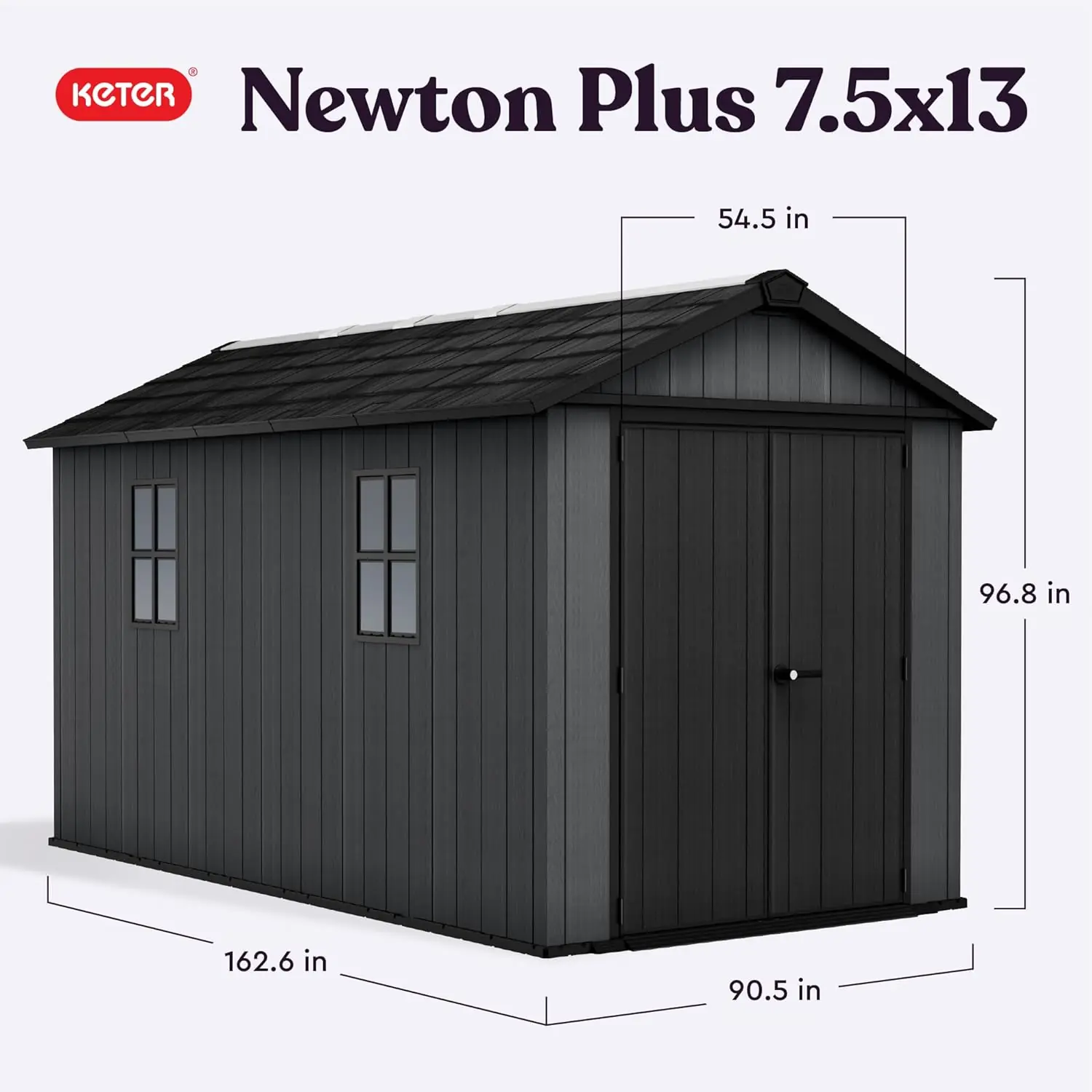
The Keter Newton Plus is a large composite storage shed, roughly 7.5 by 13 feet, built from injection-molded resin panels reinforced with steel framing. It belongs to the premium end of the resin-shed category — a step above the thin-walled plastic models you find at big-box retailers and a clear alternative to traditional wood or metal construction. It uses Keter’s Evotech+ material, which combines UV-resistant resin with a textured wood-grain finish. The double doors are about 54 inches wide, which is generous enough for a walk-behind mower or a standard wheelbarrow.
It is not a workshop-grade structure. The walls are hollow-core resin panels, not plywood or solid steel, so you cannot screw heavy shelving directly into them without modification. It is not fully waterproof in the way a rubber-sealed marine locker is — the overlap seams do an adequate job, but I would not store irreplaceable documents or electronics in it without additional protection. It is also not a quick weekend project. Plan on two full days if you are assembling alone, or one long day with a helper. The brand itself is well-established in the outdoor storage market, and Keter has been making resin sheds out of Israel for decades. That track record matters, but as with any manufacturer, it is worth reading the fine print on warranty coverage.
In the market, this sits at mid-to-premium pricing. You can buy a steel shed for half the price, but it will dent and rust over time. You can buy a wood shed for similar money, but it will demand staining and sealing every couple of years. The Newton Plus occupies the gap between those two — higher upfront cost than steel, lower lifetime maintenance than wood.
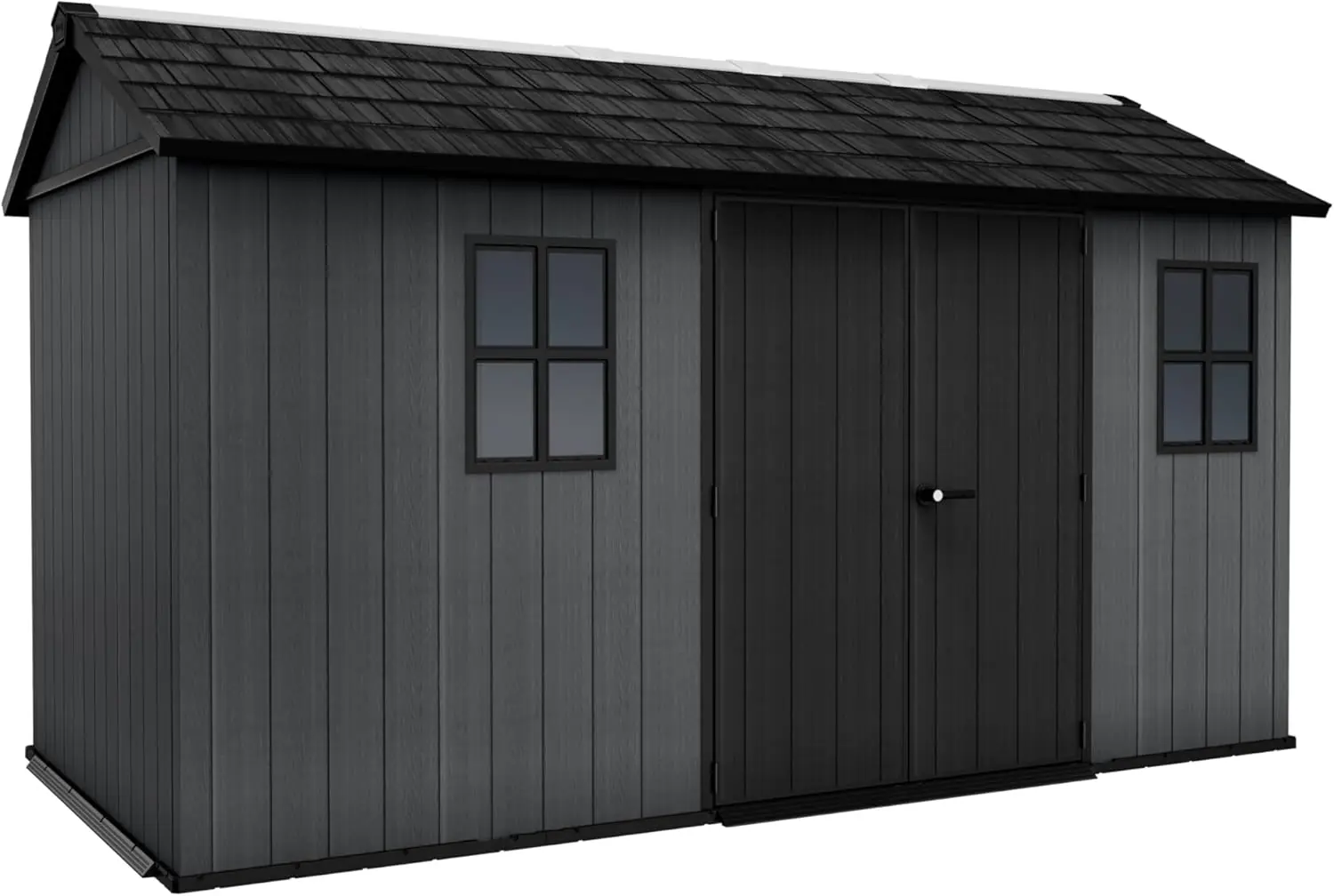
The box is heavy — over 540 pounds in total across multiple cartons. Inside you get the molded wall panels, the steel reinforcement bars, the roof panels with integrated skylight, the double doors with lock hardware, the floor panels, and a bag of fasteners. There is no foundation or base included. You will need to prepare a level surface before assembly — either a concrete pad, a gravel base, or pressure-treated lumber. Keter recommends a level foundation, and I found that advice to be non-negotiable; the panels lock together with a tongue-and-groove system that does not forgive uneven ground.
Packaging quality was decent but not exceptional. The panels are thick enough that they are unlikely to crack in transit, but one corner of my roof panel had a minor scuff. It was cosmetic and did not affect fit. A few things I noted at unpacking: the resin has a slight chemical smell out of the box, though it dissipated within a few days of assembly. The steel bars are powder-coated and feel substantial. The door hinges are plastic, which gave me pause, but they have held up fine so far.
You will need a drill, a rubber mallet, a level, a socket set, and a step ladder. I needed a second pair of hands for aligning the roof panels. That is not a complaint — it is a realistic heads-up.
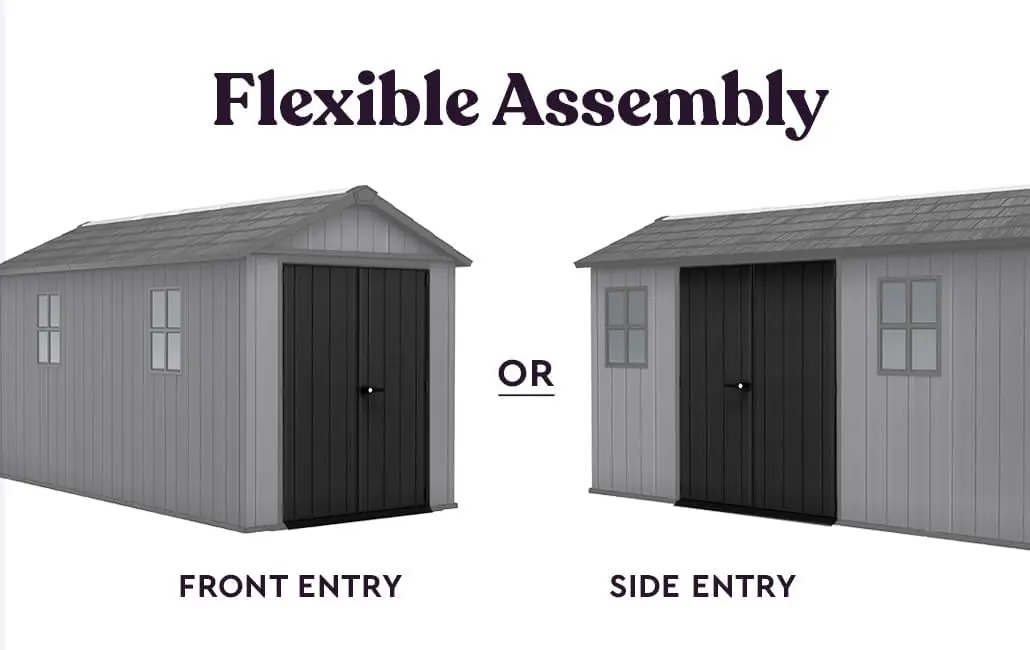
I laid out all panels and hardware on my driveway on a Saturday morning. The instruction manual is mostly illustrated, which is fine if you have assembled flat-pack furniture before, but there are a few steps where the drawings are ambiguous. I spent about 45 minutes figuring out the wall-to-floor connection sequence — it is not difficult, but it is not intuitive either. With a helper, the walls went up in about three hours. The roof took another two. By late afternoon, the shell was standing. Total time for one person: roughly 14 hours spread over two days.
The main challenge is the alignment. The panels click together with interlocking edges, and if one is slightly off, the next one will not seat properly. I had to backtrack twice to loosen adjacent panels and reseat them. The steel reinforcement bars slide into channels in the panels, and that part is straightforward. If you have built a resin shed before, you will pick this up quickly. If you have not, budget extra time for the wall section. The Keter Newton Plus review process for assembly honestly requires patience — rushing leads to gaps.
Once the doors were hung and the lock mechanism installed, I moved my mower, garden cart, and a stack of pots inside. The interior is tall enough to walk upright — 96.8 inches at the peak — and the 54-inch door opening swallows bulkier items easily. The skylight let in enough natural light that I did not need a flashlight during the day. My first reaction was relief: it looked like a wood shed but without any splinters or sharp edges. The dual-door latch felt secure. I left it overnight with a light rain forecast and checked for leaks the next morning. The interior floor was dry.
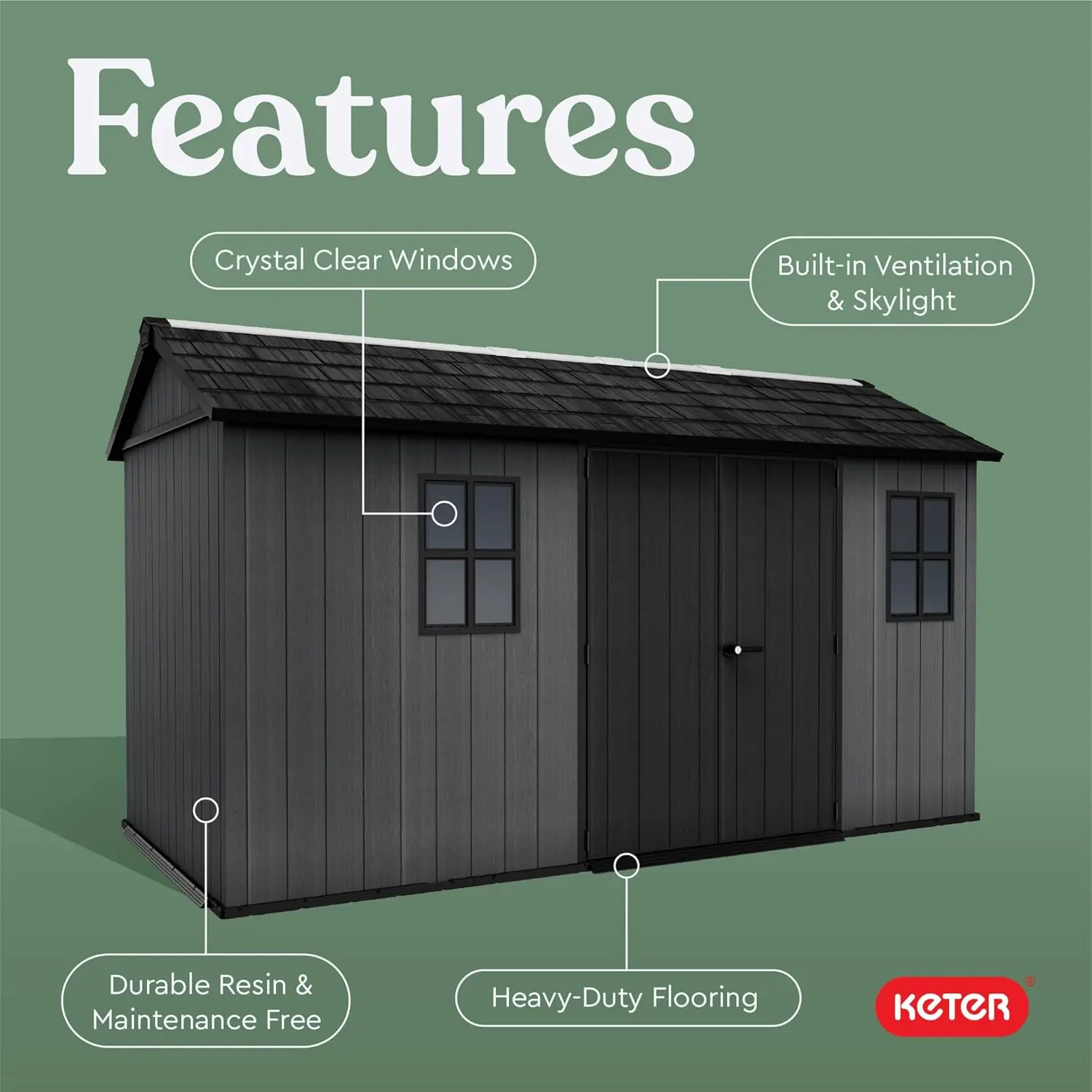
The doors settled into alignment after about a week. Initially, the latch required a firm push to engage cleanly. After a few open-close cycles, it smoothed out. I also figured out the best way to arrange the interior — heavy items along the back wall to distribute weight evenly, lighter shelves near the doors. The floor panels are ribbed for drainage, which worked well; after a wet day, any moisture that blew in evaporated quickly thanks to the built-in roof ventilation ports.
The UV resistance is real. The panels show no fading, yellowing, or brittleness after weeks of direct afternoon sun. The roof has not sagged or warped despite a few days of temperatures in the high 90s. The lock mechanism remains smooth, and the keys operate without binding. The skylight still lets in plenty of light, and the ventilation slots keep the interior from feeling stuffy. On the whole, the things that worked well on day one still work well now.
First, the floor panels sit directly on the ground if you do not install a foundation. That means dirt and small debris can creep in under the walls. I added a row of paver stones around the perimeter after week two, which solved it. Second, the skylight is great, but it also means the interior heats up more on sunny days. The ventilation helps, but if you store temperature-sensitive items, consider a shade cloth over the roof in summer. Third, the plastic door hinges work fine for the door weight, but I would not hang anything from them. If you plan to install a hasp or external lock, reinforce the mounting area with a small metal plate.
One of the corner panels developed a slight gap at the seam after a windy day. I was able to push it back into place and secure it with an extra screw (the manufacturer provides a few spares). It has not recurred. The resin surface does show dust and pollen more visibly than a wood or steel shed would, so I have been hosing it down every couple of weeks. No cracks, no rust, no fading as of week six. I will update this Keter Newton Plus review if anything changes over the next season.
| Specification | Value |
|---|---|
| Dimensions (D x W x H) | 162.6 x 90.5 x 96.8 inches |
| Weight | 542.38 lbs |
| Material | Evotech+ composite (resin), steel frame |
| Door Opening | 54.6 x 71.3 inches |
| Snow Load Rating | 30 PSF |
| Warranty | 2-year limited |
| Assembly Required | Yes |
For more on how resin composite compares to traditional materials, check our guide to outdoor storage solutions for additional context.
| What We Evaluated | Score | One-Line Note |
|---|---|---|
| Ease of setup | 3/5 | Takes two days solo; alignment can be fussy |
| Build quality | 4/5 | Thick panels, sturdy frame, but plastic hinges |
| Day-to-day usability | 4/5 | Doors open wide, interior height is generous |
| Performance vs. claims | 4/5 | Mostly accurate, but customization is limited |
| Value for money | 3.5/5 | Premium price for composite — steel offers lower cost |
| Overall | 3.8/5 | Good shed with honest limitations; best for maintenance-averse buyers |
The overall score reflects a solid product that delivers on its core promise of low-maintenance storage. It loses marks on setup difficulty and value compared to cheaper alternatives. That said, if you value zero upkeep over upfront savings, it earns its place. This Keter Newton Plus review honest opinion is that it fills a real niche but is not a universal recommendation.
| Product | Price | Strongest At | Weakest At | Best For |
|---|---|---|---|---|
| Keter Newton Plus | $1900 | Composite durability, no maintenance | High assembly effort, plastic hinges | Homeowners wanting wood look without upkeep |
| Arrow Woodridge 10×14 | ~$1200 | Lower price, steel construction | Prone to rust, sharp edges, less attractive | Budget-focused buyers with dry climates |
| Lifetime 8×10 Resin Shed | ~$1500 | Lighter weight, easier assembly | Smaller footprint, thinner walls | Compact yards with basic storage needs |
The Keter Newton Plus wins on appearance and longevity. The Evotech+ composite does not dent like steel or rot like wood. If you are in a coastal area with salt air or a region with heavy rain, the Newton Plus will outlast a steel shed by years. The skylight and ventilation are real functional benefits that most competitors lack at this price point. It also looks genuinely good — neighbors have commented that it resembles a custom-built cedar shed.
If you are on a strict budget, the Arrow Woodridge offers nearly twice the floor space for about 60% of the cost. You will need to treat it for rust and accept that it looks like a metal shed. If you have limited space or need something you can assemble in an afternoon, the Lifetime 8×10 is lighter and simpler to build. Neither competitor matches the Newton Plus on material quality, but for many buyers, the trade-offs are worth it. This Keter Newton Plus review comparison should help you decide which factors matter most to you.
For a deeper look at another outdoor storage option, see our review of the ABS Flood Barrier for related outdoor protection gear.
The right buyer for the Keter Newton Plus is someone who values appearance and zero maintenance over upfront price. If you are a homeowner with a medium-to-large yard, a collection of lawn and garden tools, and a desire to store them in something that looks like a wood structure but never needs paint or stain, this shed fits. You should be comfortable with a two-day assembly project or willing to pay for professional installation. You probably do not need to store a riding mower or ATV — the 7.5×13 footprint is generous for hand tools and walk-behind equipment, but tight for vehicles. You prioritize durability and are willing to pay a premium for composite material that will not rust, rot, or fade.
The wrong buyer is someone who needs maximum space for minimum money. If you want to store large equipment or use the shed as a workshop with heavy shelving, look at a wood or steel alternative. If you are looking for an inexpensive solution for a few trash cans and a hose, this is overkill. Do not buy the Newton Plus if you plan to move within a few years — it is heavy and not easy to disassemble. In that case, a lighter steel model or even a portable shelter makes more sense. The is Keter Newton Plus worth buying question depends entirely on whether you value the composite material enough to pay for it.
At 1900.79USD, the Newton Plus sits at a premium compared to similarly sized steel sheds, which often run $1000–$1300. It is roughly on par with mid-range wood sheds, though wood requires ongoing maintenance costs. For the composite material, the price is fair — you are paying for a structure that should last 10–15 years with zero painting or sealing. The value proposition improves if you factor in the skylight and ventilation, which are not available on most metal models.
I bought mine through Amazon, which had the best price at the time and offered free delivery. The shed ships in multiple boxes, and the freight carrier brought them to my driveway. I recommend verifying that the seller is an authorized Keter dealer to ensure warranty validity. The two-year limited warranty covers defects in material and workmanship but does not cover damage from improper assembly or extreme weather beyond the rated snow load. I have not needed to test the warranty, but Keter’s customer service was responsive when I asked a pre-purchase question about foundation requirements.
Price and availability change. Check current figures before deciding.
The two-year limited warranty covers manufacturing defects. Keter will replace defective parts if you provide proof of purchase and photos. Some online forums report slow response times, but my experience was a three-day turnaround on a question about replacement screws. The warranty does not cover cosmetic issues like scratches or minor warping from sun exposure.
Yes, if you value a maintenance-free exterior that looks like wood. The composite material will not rot, rust, or need paint, which saves hundreds of dollars and many weekends over a decade. If you just need basic storage and do not care about appearance, a steel shed at half the price will do the same job. The value is in the material, not the capacity.
The Arrow Woodridge is steel, costs about $700 less, and comes in larger sizes. It is easier to assemble but will rust over time in humid climates. The Keter Newton Plus looks far better, lasts longer, and requires no maintenance. The Arrow is a functional box; the Keter is a piece of outdoor furniture. Choose based on whether aesthetics and longevity matter more than price.
I took about 14 hours spread over two days working alone. A second person cuts that to roughly 8–10 hours in a single day. The most time-consuming part is aligning the wall panels and seating the roof. The instructions are adequate but not great — watching a few assembly videos on YouTube beforehand saved me about an hour.
You need a level foundation. I used a 10×12 concrete pad that cost about $400 to have poured locally. You can also use gravel or treated lumber, but concrete is best. Beyond that, a drill, socket set, rubber mallet, and step ladder are sufficient. If you want interior shelving, you will need to buy a separate system or use the included wall inserts with standard brackets. Check the product listing for any current bundle deals.
In six weeks, I had one corner panel gap after a windstorm that I fixed with an extra screw. The plastic hinges have not worn or cracked. I have seen reports from owners who have had the shed for a year reporting no issues with fading or warping. The composite material seems durable, but the hollow walls mean you cannot hang heavy items easily. That is a design limitation, not a reliability issue.
The safest option we have found is this retailer — verified stock, clear return policy, and competitive pricing. I purchased from Amazon and received genuine Keter packaging with all included parts. Avoid third-party sellers offering prices significantly below market; the composite panels are expensive to manufacture, and deep discounts often indicate a damaged or incomplete shipment.
Not safely without adding electrical work. The resin panels are not fire-rated, and there are no pre-cut electrical conduits. If you need a workshop with power, run an outdoor-rated extension cord from your house and use a GFCI-protected outlet. I store power tools but charge batteries inside the house.
I experienced two heavy downpours and found no leaks. The skylight is a single molded polycarbonate panel with a raised lip that overlaps the roof panels. The seal is rubber gasketed. I cannot guarantee it will hold up in hurricane-force rain, but for normal storms it has been dry.
Two things decided it. First, the skylight. I walk into the shed and I can see everything immediately — no fumbling for a flashlight, no overhead bulb to maintain. Second, the composite material. I have owned a steel shed before and watched it rust at the corners within three years. This will not. The assembly was frustrating at times, but now that it is up, I do not think about maintenance at all. That peace of mind is worth the premium to me.
This Keter Newton Plus shed review verdict is a cautious recommendation. Buy it if you want a low-maintenance, good-looking shed that will last. Do not buy it if you need maximum square footage for your dollar or if you plan to use it as a heavy workshop. I would buy it again at this price, knowing what I know now. That said, if I were on a tighter budget, I would buy a steel shed and plan to replace it in five years. The Newton Plus is for people who value time over money.
I have been testing this shed for six weeks, and I know there are owners who have had it for seasons longer. If you have experience with the Newton Plus — good or bad — I would like to hear it. Drop your observations in the comments below. And if you are ready to buy, you can get the Keter Newton Plus here.
Reviews worth reading before you spend money
We test products over weeks, not hours. No sponsored rankings. No affiliate-first conclusions. Join readers who use our work to make better decisions.