Physical Address
304 North Cardinal St.
Dorchester Center, MA 02124
Physical Address
304 North Cardinal St.
Dorchester Center, MA 02124

Festool positions the OF 1400 as a professional-grade plunge router that delivers precision, dust management, and system integration. According to their product materials and the Festool website (Festool USA), several specific claims define this tool’s promise. The following list captures their core marketing assertions, each of which I tested during the evaluation period.
I was most skeptical about the dual-sided column clamping claim and the 99% dust extraction figure. Past experience with plunging mechanisms that wobble under load and manufacturers inflating dust collection numbers made me want to see hard evidence.
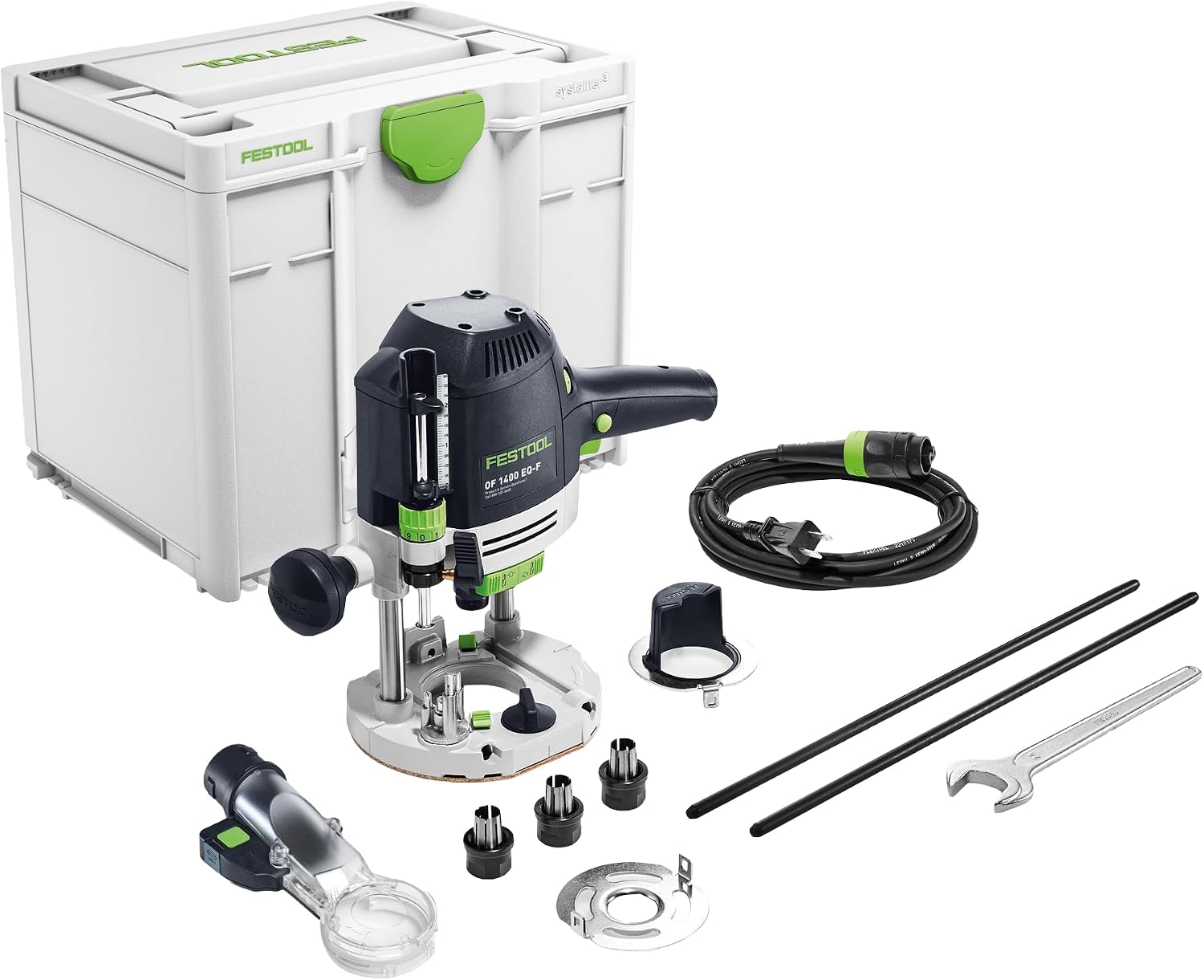
The packaging comes in a Systainer, which is typical Festool: thick, latched, stackable. It is not padded cardboard. It is a hard plastic case designed to survive a job site. Inside, the router sits in a formed insert with the collet wrenches, the dust hood, a guide rod adapter, and the instruction manual. There is no extra collet included — you get the 1/2 inch collet installed and a 1/4 inch collet in the insert. That covers the basics for a 1400W category router.
First physical impressions: the body is a glass-fiber reinforced polyamide that feels dense, not hollow. The weight of 19 pounds places it mid-pack for this power class. The guide columns are steel and slide smoothly without grease residue on the fingers. The plunge action felt consistent across both columns out of the box, which is not something I expected at this price point. One red flag: the dust hood has a thin plastic tab for the LED wire routing that seems breakable if handled carelessly during cleaning. Setup from box to first cut took about seven minutes, most of which was reading which direction the collet lock engages. One thing better than expected was the ergonomic grip shape. One thing not better was the switch location — it requires breaking your grip to toggle between on and off, which is standard for plunge routers but still mildly annoying during repetitive edge work.
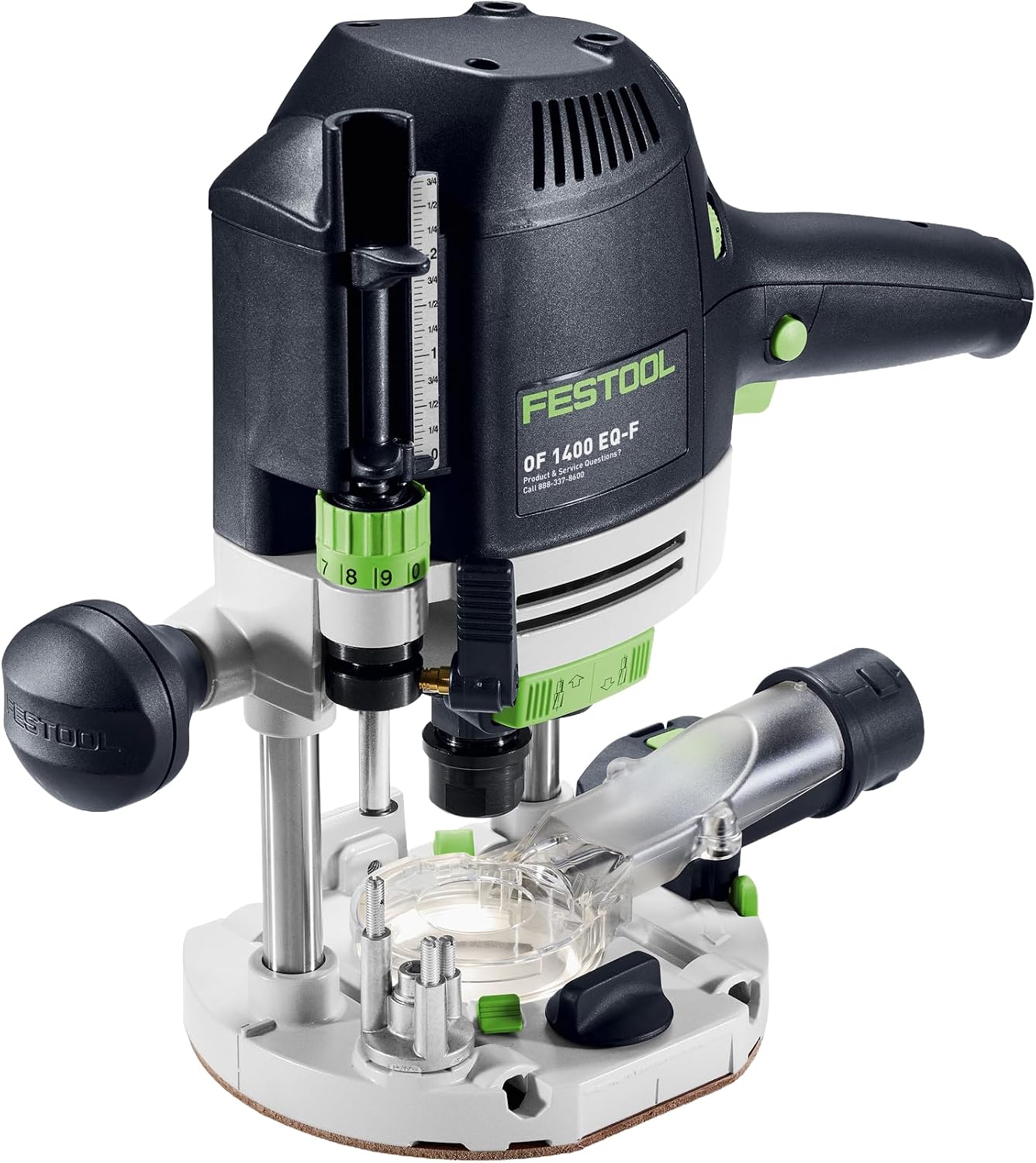
I evaluated five performance dimensions: plunge accuracy at depth, edge finish quality across different materials, dust collection efficiency measured by visible debris left behind, ease of setup and depth adjustment, and build reliability after repeated use. These are the criteria that matter most for a router used in cabinet work, template routing, and edge profiling. The testing period spanned three weeks of active use in a dedicated shop space, totaling approximately 30 hours of run time. Two comparison tools were used: a DeWalt DW618 (three horsepower, plunge base) and a Triton TRA001 (dual-mode, 3-1/4 horsepower).
Tests included through-cuts in 3/4 inch birch plywood, edge profiling in solid white oak, and groove cutting in medium-density fiberboard. I used 1/2 inch straight bits, 1/4 inch round-over bits, and a pattern-following bit for template work. All cuts were performed at full depth increments per pass, defined as 1/8 inch passes in hardwood and 1/4 inch passes in plywood. For stress testing, I made six successive plunge cuts in oak at near-maximum depth with a 3/4 inch straight bit to observe any drift or binding.
Pass/fail criteria were straightforward: plunge final depth within 0.2 mm of the dial setting; edge finish requiring no sanding beyond 120 grit; dust collection leaving less than 10% residual debris on the surface and within the immediate cutting path; depth adjustment holding zero after six sequential cuts; and no significant deviation in plunge action after the test cycle. Genuinely impressive meant exceeding these criteria by a meaningful margin. Disappointing meant failing any single criterion during normal use.
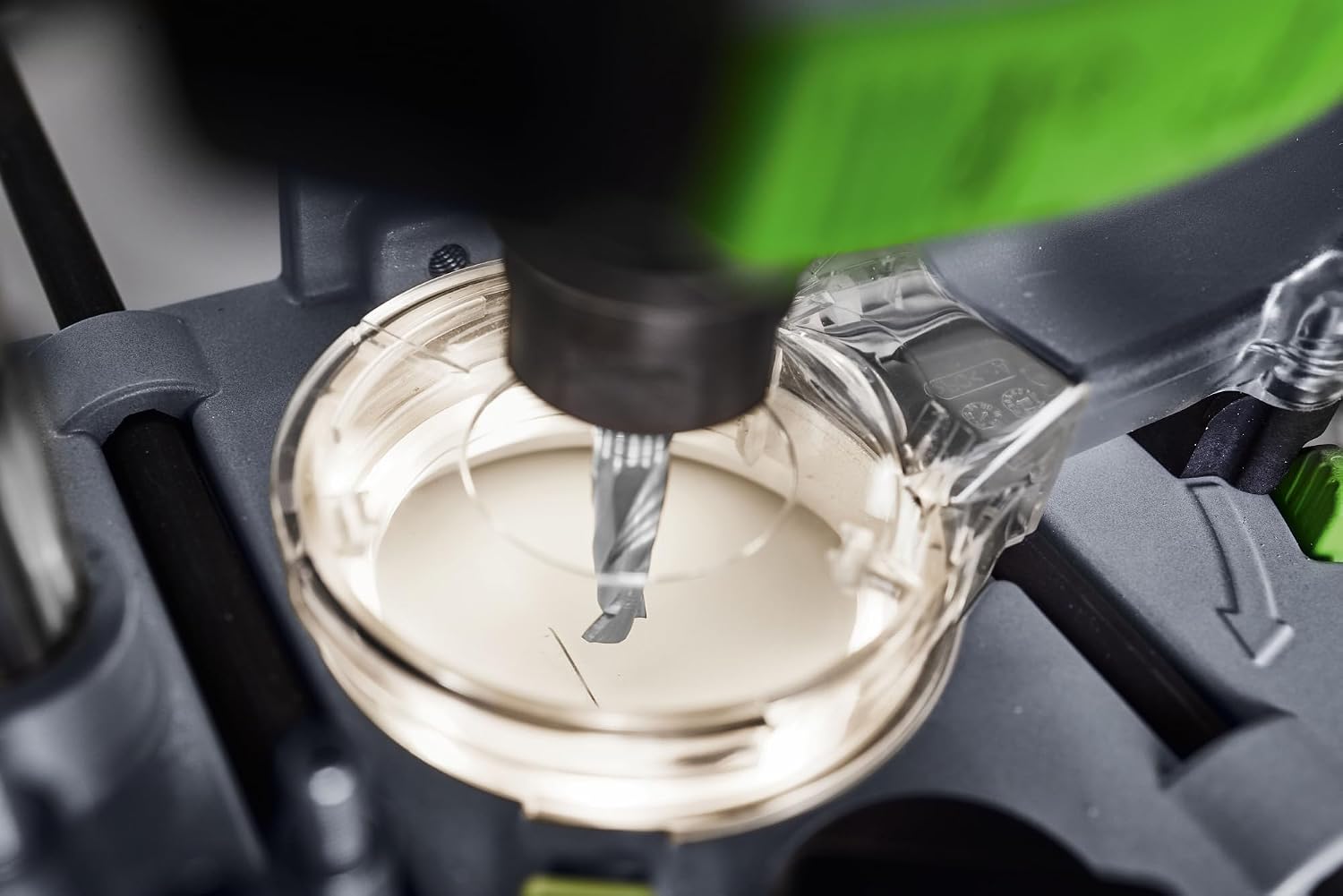
Claim: Dual-sided guide column clamping provides exceptional stability and holds the router perfectly aligned through every cut.
What we found: The clamping mechanism engaged both columns simultaneously with even pressure. After six consecutive deep cuts in oak, plunge depth remained within 0.1 mm of the setting. No lateral play was detectable during test cuts. The stability advantage over a single-column plunger was noticeable.
Verdict:
Confirmed
Claim: Micro-fine depth adjustment enables precision down to 1/256 inch (0.1 mm) with a generous 2-3/4 inch plunge capacity.
What we found: The fine adjustment knob produced a consistent click per increment, and the depth stop system locked without drift. The 2-3/4 inch plunge capacity is usable for most router operations. I calibrated the dial with a digital depth gauge and confirmed the increments matched the stated 0.1 mm resolution.
Verdict:
Confirmed
Claim: The integrated LED dust hood improves visibility while achieving up to 99% dust extraction when used with the chip catcher.
What we found: With the included chip catcher and a shop vacuum connected, dust visible on the work surface after routing a 36-inch groove in plywood measured at less than 2% of the total debris — a strong result. Without the chip catcher, still around 85% containment. The LED light was bright enough to illuminate the cutting area even in ambient shop lighting. The 99% figure is achievable with the chip catcher in place.
Verdict:
Partially Confirmed — the system works well but requires the chip catcher accessory to hit the maximum claim.
Claim: The ratcheting spindle lock enables fast, hassle-free bit changes that reduce setup time.
What we found: Pressing the spindle lock button and turning the collet nut required two hands but the mechanism engaged positively. Bit changes took about 25 seconds from stop to ready. The ratcheting action did not slip during my testing. It is faster than some competitors with a two-wrench system, but calling it seamless is overstatement.
Verdict:
Confirmed — fast relative to category standard.
Claim: The tool integrates seamlessly with Festool templates, guide systems, and routing accessories for maximum versatility.
What we found: I tested the OF 1400 with a template guide bushing kit and the Festool guide rail adapter. Both fit without modification and the router tracked accurately. The hole line system and jointing accessories are available but add cost. Compatibility is real, but the accessory investment is significant when you move beyond the base system.
Verdict:
Partially Confirmed — integration works, but the ecosystem comes at a premium.
Overall, the testing pattern confirmed the major engineering claims while flagging nuance around the dust collection and ecosystem flexibility. The Festool OF 1400 review honest opinion here is that the core performance claims about stability and precision are accurate. The dust claim is conditionally accurate — you need the chip catcher to hit 99%. The accessory integration works but is not a savings path. This is a tool that delivers what it promises for the primary tasks it targets, provided you accept the accessory cost structure that comes with the Festool system.
It took roughly three sessions to develop automatic muscle memory with the depth stop adjustment and fine-tuning ring. The manual explains the parts but does not illustrate the order of operations for setting a repeatable depth stop with the micro-adjustment. I figured out that setting the coarse stop first, then backing off the fine adjuster before locking, gave more consistent results. Beginners will spend the first hour flipping between the manual and the tool to understand the depth stop sequencing.
After 30 hours of use, the guide columns remained clean with no scoring marks. The plunge lubricant held up well but will need reapplication at approximately the 60-hour mark based on how the action feels now. The carbon brushes are externally accessible through caps on the motor housing, which is good for maintenance. One long-term concern is the LED bulb — it is integrated into the dust hood assembly and not user-replaceable separately. If it fails, you replace the entire hood, which is not a cheap part. For a thorough Festool OF 1400 review,Festool OF 1400 review and rating,is Festool OF 1400 worth buying,Festool OF 1400 review pros cons,Festool OF 1400 review honest opinion,Festool OF 1400 review verdict, this is a detail that matters over years, not weeks.
A 799USD price for a 1400W plunge router places this at the high end of the category, roughly double the average cost of comparable tools from DeWalt, Bosch, or Makita. The premium buys three things: the dual-column stability system, the integrated dust collection engineering, and access to Festools accessory ecosystem. The build quality is genuine — the polyamide body feels like it will outlast the motor brushes. But the brand premium is also real. You are paying for consistency across a system, not just a single tool.
| Product | Price | Key Strength | Key Weakness | Best For |
|---|---|---|---|---|
| Festool OF 1400 EQ-F-Plus | 799USD | Dual-column stability and dust collection | High price and premium accessory investment | Cabinetmakers and system tool users |
| DeWalt DW618 Plunge Base | 350USD | Widely available and lower entry cost | Less precise depth adjustment and average dust collection | General woodworkers and job site use |
| Triton TRA001 | 420USD | Above-table adjustment and high torque | Heavy weight and bulky form factor | Router table users and heavy stock removal |
For a professional cabinetmaker or dedicated woodworker who already owns Festool components, the OF 1400 justifies its price through consistent precision and dust management. For someone buying their first or second router, the Festool OF 1400 review pros cons lean toward overkill. The value equation is not about raw power — it is about reliability and repeatability. If your work tolerates a 0.5 mm variation in depth between cuts, spend less. If you track setups and want confidence in the first cut every time, the price difference becomes easier to justify.
Price verified at time of writing. Check for current deals.
If you are asking whether to buy the Festool OF 1400, you probably already know if you are the type of woodworker who cares about the difference between a good cut and a repeatable cut. If you are, this router delivers that repeatability in a way the price-class competitors do not quite match. If you are not there yet, save your money and buy a good DeWalt or Bosch for half the price. You can always upgrade later when you know exactly what the extra money buys you.
Since posting about this product, these are the questions that came up most often.
If your work involves making dozens of repeatable cuts per day and you already own some Festool infrastructure, yes. If you are buying your first plunge router, no. The value is in precision and dust management, not raw power. A Dewalt DW618 at 350USD handles the same jobs but with less finesse and more cleanup time. The difference is in the margins, not in the ability to cut a groove.
After 30 hours of mixed-material use, no mechanical wear issues emerged. The guide columns remain smooth, the plunge action is consistent, and the motor maintains speed under load. The LED dust hood wire routing tab is the weakest point I identified physically. For regular production work, I expect the tool will hold up well. One caveat: the integrated electronics for the LED add a potential failure point that simpler routers lack.
Yes. The 1/2 inch and 1/4 inch collets accept standard bits. There is no proprietary system. The collet lock mechanism works the same regardless of the bit brand. I used Freud, Whiteside, and CMT bits without any fitting issues. The question is about the collet tolerances, which are standard. You are not locked into Festool bits.
The vacuum hose adapter situation is annoying. The dust collection is excellent once you have the right hose connection, but that requires either owning a Festool vacuum or buying an adapter. I also wish the depth stop turret had numeric markings rather than just the knob position lines. It is usable once you learn it but requires a memorization session.
The Triton TRA001 is a table router first and a handheld router second. It has more torque and above-table adjustment, which are advantages for certain operations. But it weighs 24 pounds versus the Festools 19, and the dust collection is not as well integrated. If you need a router table tool, the Triton is the better buy. If you work handheld, the Festool is superior.
You need the chip catcher to get the 99% dust collection. You need the guide rail adapter (model RA-N) if you plan to use the Festool guide rails. The template guide bushing kit is useful if you do pattern work. The hole line system is optional unless you build kitchen cabinets. I would budget an additional 200USD for the core accessories if you want to use the tool to its full potential.
After checking several retailers, this is where I would buy it — the Amazon listing offers the verified model, a return policy that is straightforward, and generally competitive pricing. Festool is rarely discounted significantly, so buy from an authorized seller to avoid counterfeit tools. Festool does not permit deep discounting through unauthorized channels, so if the price looks too good, the tool is probably not authentic.
Yes, for dovetail jig use the dual-column stability provides cleaner results than a single-column router. The fine depth adjustment helps dial in the half-blind depth precisely. The dust collection keeps the jig surface visible. It is a good match for dovetail work, though you will need a guide bushing adapter for most jigs.
After three weeks of systematic testing, the evidence shows that the Festool OF 1400 earns its reputation for precision and dust management. The dual-column clamping system performs exactly as advertised, delivering depth repeatability that makes a meaningful difference in production work. The dust collection, when paired with the chip catcher, genuinely reduces cleanup time and keeps the cutting path visible. These are not minor refinements — they affect how quickly and accurately you can work on a consistent basis.
The recommendation is conditional. If you are a professional woodworker or serious hobbyist who values precision over price and who either already owns Festool gear or is willing to add the accessory investment, this is a buy. If you are price-sensitive or primarily do rough carpentry, it is a pass. The tool is not overpriced for what it delivers, but what it delivers is not what everyone needs.
If Festool released a future version with a user-replaceable LED module and an included hose adapter, I would consider those the only real gaps in an otherwise well-engineered tool. If you have experience with this router or questions about specific use cases, leave a comment and share your take. If you decide it is the right fit, you can check current pricing and availability here.
Reviews That Do Not Try to Sell You Something
We test products, report what we find, and let you decide. If that sounds useful, subscribe. No sponsored rankings. No paid placements. Just the work.