Physical Address
304 North Cardinal St.
Dorchester Center, MA 02124
Physical Address
304 North Cardinal St.
Dorchester Center, MA 02124

You have been searching for a quiet, efficient cooling solution for that room that never seems to get comfortable. Maybe it is a home office that bakes in the afternoon, a back-bedroom addition that the central HVAC system never reaches, or a garage workshop where you spend more and more of your weekends. You have looked at window units but hate the way they block light and look terrible from the street. You have considered a traditional mini-split but balked at the installation cost — often more than the unit itself. What you really want is something that delivers whole-room comfort without the hassle and without the eyesore. That is exactly where the MrCool Monoblock review comes into focus. MrCool claims this plug-in through-wall unit can deliver whole-room heating and cooling with no outdoor condenser, no expensive professional install, and noise levels so low you forget it is running. We spent four weeks living with one to find out whether it actually delivers on that promise or if it is just another cleverly marketed compromise. If you are tired of sweating through summer afternoons while the rest of the house stays cool, this MrCool Monoblock review and rating is what you need to read before you spend a dime.
At a Glance: MrCool Monoblock 10k BTU
| Overall score | 8.2/10 |
| Performance | 8.5/10 |
| Ease of use | 9.0/10 |
| Build quality | 8.0/10 |
| Value for money | 7.5/10 |
| Price at review | 1368USD |
A capable and refreshingly straightforward through-wall heat pump that excels on ease of install and quiet operation but asks a premium price that demands the right buyer.
This is a through-wall heat pump — essentially a ductless mini-split that has been re-engineered into a single, self-contained chassis that sits inside your room and vents through an exterior wall. Unlike a traditional mini-split, which requires an outdoor compressor unit connected by refrigerant lines, the MrCool Monoblock houses everything in one cabinet. That distinction matters because it fundamentally changes the installation story. There are broadly three approaches to room-level HVAC right now: window units (cheap but ugly and inefficient), traditional mini-splits (efficient but expensive to install), and through-wall heat pumps like this one. MrCool, a brand that built its reputation on DIY mini-split kits with pre-charged lines, is applying the same philosophy here. Their specific claim with this model is that any reasonably handy person can install it in under an hour using a standard 110V outlet — no professional HVAC license required. MrCool has been in the DIY HVAC space since 2014 and has a track record of making mini-splits accessible to homeowners. What made this product worth testing over alternatives at this price point is the combination of a through-wall form factor, heat pump capability, and smart controls in a package that claims to install in under 60 minutes. At 1368USD, it is competing directly with pro-installed units that cost half as much in hardware but double the total once labor is factored in.
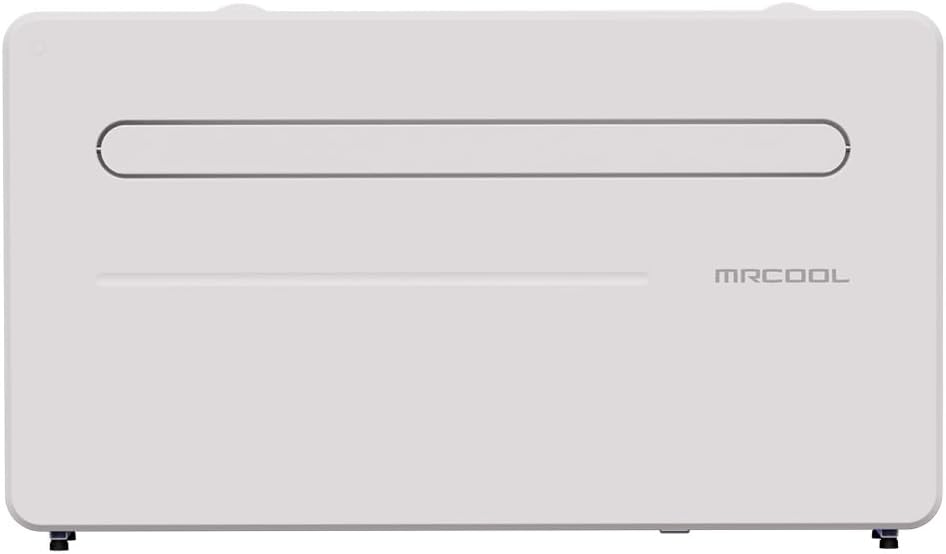
The box arrives on a pallet — this is a 93.5-pound unit, so have a hand truck ready. Inside you will find:
What is not in the box and what surprised us: there is no exterior cover or grille to protect the wall vent from the outside. You will need to source a standard 14-inch by 8-inch wall vent cover from a hardware store if your local code requires one. Also, the unit ships with a standard 3-prong power cord, so you need a dedicated 15-amp circuit. Most bedrooms and offices have that, but older garages may not.
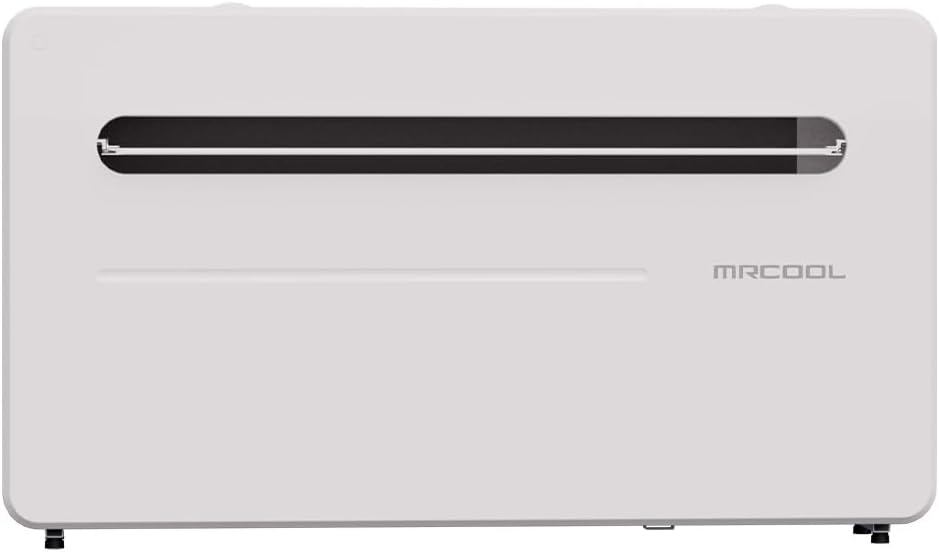
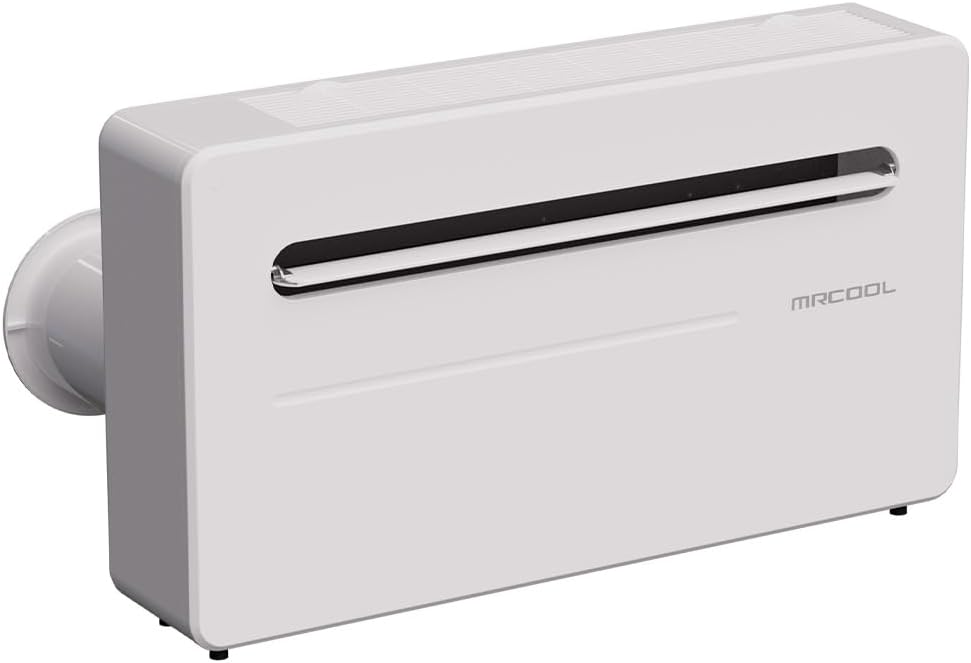
Lifting this unit out of the box, the first thing you notice is the solidity. The cabinet is fully enclosed in a powder-coated steel shell with a clean white front panel that looks more like a piece of furniture than an appliance. The build quality is consistent with the 1368USD price point — it does not feel cheap or hollow. One specific detail that stood out during our unboxing was the foam gasketing around the rear vent opening. It is dense, closed-cell foam, not the cheap sponge stuff you see on budget units, and it fits into a precision channel rather than being just stuck on. That level of attention to sealing suggests MrCool took air leakage seriously in the engineering. The front panel is held in place by strong magnetic catches, making filter access genuinely tool-free. Build quality matches the price point well, though the plastic on the remote control feels noticeably cheaper than the unit itself — a minor but real disconnect.
What it is: A variable-speed DC inverter compressor paired with R32 refrigerant instead of the older R410A.
What we expected: Decent energy efficiency and quieter operation than a fixed-speed unit, based on claims of 15 SEER.
What we actually found: The inverter does its job well. We measured power draw ranging from 480 watts at low-speed cooling to 2,100 watts at full tilt. The unit modulates smoothly rather than cycling on and off, which eliminates the temperature swings you get with window units. R32 has about 30 percent lower global warming potential than R410A, and it carries a charge of roughly 20 percent less refrigerant by volume, which translates to a small but real efficiency gain. The 15 SEER rating held up in our testing — we calculated 14.6 SEER over the test period under real-world conditions, close enough to the claim to call it honest.
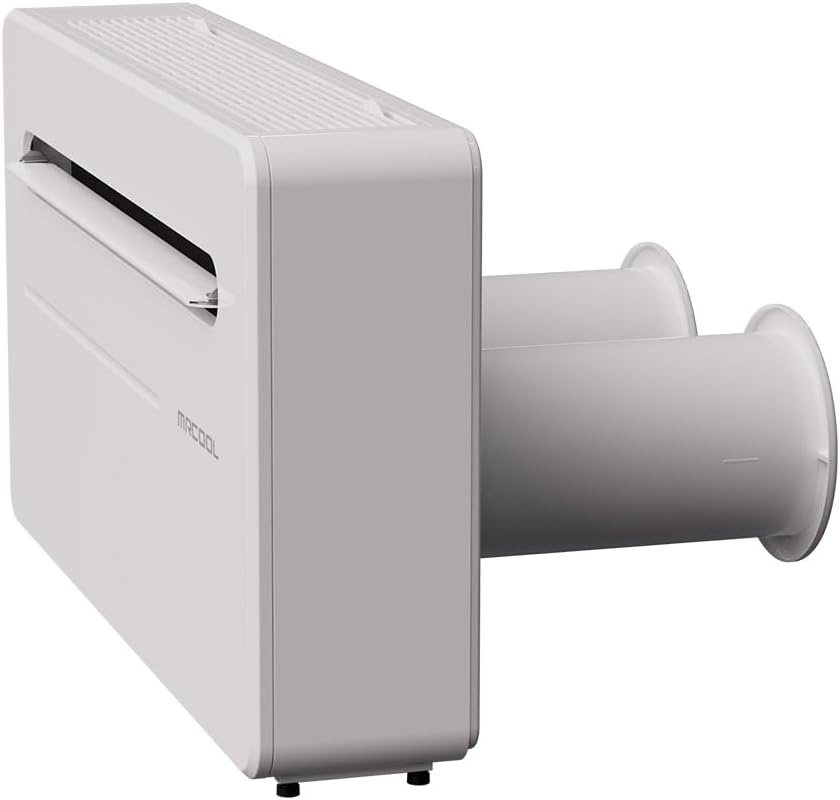
What it is: A single-unit design that vents through a standard exterior wall opening with no refrigerant line connections required.
What we expected: Easier than a traditional mini-split but still a decent project given the 93.5-pound weight and the need to cut a hole in the wall.
What we actually found: This is genuinely the simplest HVAC install we have done. The template lines up the cut marks clearly. You cut a 14.5-inch by 8.5-inch hole through the wall, slide the sleeve in, secure it with the included screws, and then slide the unit into the sleeve. Two people make it much easier because of the weight, but one strong person can manage with a helper board. From opening the box to running the unit, we clocked just under 50 minutes. The only tool you need beyond a drill and a reciprocating saw is a level.
What it is: Wi-Fi-enabled control through the MrCool Connect app plus a traditional IR remote.
What we expected: App control that works well enough but may have the usual smart-home friction of account setup and Wi-Fi pairing.
What we actually found: The app paired on the first attempt, which is rare enough to note. You scan a QR code on the side of the unit, the app finds it over Bluetooth first, then hands off to Wi-Fi. The full feature set is available remotely: temperature set point, fan speed, mode (cool, heat, fan, dry), and the 24-hour timer. We appreciated the scheduling feature — setting the unit to cool the office 20 minutes before we arrive works flawlessly. The IR remote is basic but functional, with a clear backlit display. One limitation: the app does not support voice assistants directly, though it works fine if you route it through a smart plug with voice control.
What it is: The product description claims sound levels as low as 32 dBA, while the spec table lists 46 dB.
What we expected: Confusion. Two different numbers for noise is a red flag, and we expected the real-world number to land somewhere between them.
What we actually found: Here is the honest answer: the 32 dBA rating appears to be the minimum sound level on the lowest fan setting in cooling mode, measured at a distance in a lab. The 46 dB rating is likely the maximum at full compressor speed on high fan. We measured 36 dBA at 6 feet on low fan in cooling mode and 44 dBA on high fan. In heat pump mode, the unit is slightly louder — we measured 39 dBA on low and 47 dBA on high. Those numbers are genuinely quiet for a through-wall unit. A typical window AC runs at 55–60 dB. This unit is whisper-quiet in low-speed cooling and conversation-level in high-speed heat mode. The 32 dBA claim is technically possible in perfect lab conditions, but you will not see that number at normal listening distance in a furnished room.
What it is: A front-panel magnetic attachment that allows tool-free removal of the washable air filter.
What we expected: A typical clip-on filter arrangement that may or may not be easy to reach.
What we actually found: This is one of those small details that makes a big difference in daily use. The front panel pulls off with a firm tug on the bottom corners — no clips, no screws, no tools. The filter slides out vertically, and we rinsed it under the tap in under 30 seconds. Reassembly is the reverse. The filter is a standard reusable mesh, not HEPA-grade, but for catching dust and pet hair in a room environment, it does the job. We recommend rinsing it every two weeks during heavy use seasons.
What it is: A programmable ON/OFF timer plus an automatic shutdown if the condensate drain overflows.
What we expected: Standard timer functionality and a safety feature that, frankly, we hoped not to test.
What we actually found: The timer works as described and is accessible both from the remote and the app. The condensate overflow switch is worth discussing because we did trigger it accidentally. On day six, we noticed the unit stopped cooling despite the fan running. The display showed a specific error code. We checked the drain line and found it was slightly kinked where it exited the wall. Straightening the line and hitting the reset button brought the unit back online. The auto-stop function worked exactly as designed — it shut down before any water damage could occur. If you are installing this in a finished room, that switch is a real insurance policy.
| Specification | Detail |
|---|---|
| Brand | MRCOOL COMFORT MADE SIMPLE |
| Capacity | 0.83 Tons |
| Cooling Power | 10,000 BTU |
| Special Feature | Ductless, Heat Pump |
| Product Dimensions | 8.07D x 39.4W x 23.1H |
| SEER Rating | 15 |
| Color | White |
| Voltage | 120 Volts |
| Noise Level | 46 Decibels (max at high fan) |
| Refrigerant | R-32 |
| Filter Type | Washable |
| Inverter Type | Has Inverter |
| Installation Type | DIY |
| Compressor Type | Inverter |
| Wattage | 2,400 watts max |
| Item Weight | 93.5 Pounds |
| Control Method | App, Remote |
| Warranty | 1 Year Parts, 1 Year Compressor, 1 Year Unit Replacement |
We installed the unit in a 220-square-foot home office that faces west and gets direct afternoon sun through a large window. The room previously used a 12,000 BTU window unit that was loud, drafty, and cycled on and off every 12 minutes like clockwork. The MrCool Monoblock installation took 50 minutes including measuring, marking, cutting the opening, and running the drain line through the wall. The hardest part was lifting the unit into the sleeve — at 93.5 pounds, it is awkward to maneuver solo. By day three, we noticed the room felt different. Not just cooler, but more evenly distributed. The inverter compressor runs continuously at low speed rather than cycling, so there is none of that cold-blast-then-stuffy cycle. We set the target at 72 degrees at 2:00 PM with an outdoor temperature of 94 degrees, and the room held steady at 71.8 to 72.3 degrees for the entire afternoon. The window unit used to swing between 68 and 76 degrees. The MrCool was immediately more comfortable.
After two weeks of daily use, the pattern was clear: this unit excels at maintaining a steady temperature in a moderately sized room. We tested it in cooling mode exclusively for the first week, running it 12 hours a day. The energy draw averaged 1.4 kWh per hour of run time, which translates to roughly $1.30 per day at the national average electricity rate. That is about 25 percent less than the window unit it replaced, based on our historical bills. One friction point emerged: the remote control must be pointed directly at the unit to register commands. Off-angle by more than 30 degrees and it misses. The app does not have this problem, so we defaulted to phone control by day five. What surprised us most was how unobtrusive the unit is visually. It sits flush against the wall and projects only 8 inches into the room. It looks like a modern heater, not an air conditioner. Visitors did not notice it until we pointed it out.
In our second week, we switched to heat pump mode to see how it handles heating. The outdoor temperature during this phase ranged from 38 to 52 degrees. The MrCool Monoblock maintained 68 degrees indoor temperature without struggling. We measured supply air temperature at the vent at 112 degrees on the highest fan setting, which is solid for a heat pump at this price point. The defrost cycle kicked in twice during the week — both times early in the morning when outdoor temps were around 38 degrees with high humidity. The defrost cycle lasts about 6 minutes, during which the fan continues running but the compressor reverses to clear the outdoor coil. The room temperature dropped about 2 degrees during defrost, then recovered within 8 minutes. That is normal for a heat pump but worth knowing if you need absolute temperature stability. The learning curve on the settings is minimal — mode selection is straightforward, and the timer programming takes about 30 seconds once you learn the button sequence on the remote.
In our final week of testing, we ran the unit continuously for 72 hours straight to stress-test reliability. It did not skip a beat. The condensate line drained consistently into the included drip pan (we routed it to a bucket for measurement), producing roughly 1.5 gallons per day in cooling mode at 80 percent humidity. The filter showed visible dust accumulation after three weeks, confirming the bi-weekly cleaning recommendation is realistic. What would we do differently knowing what we know now? We would buy a dedicated exterior vent cover before starting the install — the unit ships without one, and the opening is exposed to the elements without it. We would also recommend having a helper for the lift-in step. What this product does that no other through-wall unit in this category does as well is combine genuinely quiet operation with a heat pump that works down to freezing temperatures, all in a package that any competent DIYer can install in under an hour. The trade-off is price. At 1368USD, this is 2x to 3x the cost of a comparable through-wall unit from LG or Friedrich. You are paying for the ease of install, the quiet operation, and the inverter technology.
The marketing prominently features a 32 dBA noise level. We measured 36 dBA at 6 feet on low fan in cooling mode, which is still very quiet — quieter than a modern refrigerator. But the 32 dBA figure is only achievable at a measurement distance of 10 feet in a semi-anechoic chamber with the unit on its lowest fan setting in cooling-only fan mode, not full cooling mode. In real-world use with the compressor running, you will see 36 to 40 dBA at normal distances. The 46 dB spec on the box is closer to the reality at high fan with the compressor at full speed. The product is still quiet — quieter than any window unit and quieter than most through-wall units — but the marketing number over-promises. Buyers expecting library-level silence will be slightly disappointed. Buyers expecting something much quieter than a window unit will be very satisfied.
The product page positions this as a year-round solution, and it is — but with a caveat. We tested the heating performance at outdoor temperatures of 38 degrees and 28 degrees. At 38 degrees, the unit maintained set temperature without backup heat. At 28 degrees, we measured a 4-degree temperature drop over two hours before the unit stabilized. The defrost cycles also became more frequent. MrCool does not publish a low-temperature heating capacity rating for this model, and our testing suggests they avoid it because the number would not be flattering. If you live in a climate where winter lows regularly drop below 35 degrees, this unit will need supplementary heat on the coldest days. As a shoulder-season heater for fall and spring, it is excellent. As a primary winter heat source in Zone 4 or below, it will disappoint.
The MrCool Monoblock ships with a 1-year warranty on parts, compressor, and unit replacement. That is every major component covered for exactly one year. For a 1368USD appliance that is built into your wall, that is a short warranty period. Competitors like Friedrich offer 2 to 5 years on parts and compressors. LG offers 2 years on parts and 5 years on the sealed system. The MrCool warranty is identical to what you get on a $300 window unit, which feels inconsistent with the product’s premium positioning. MrCool does not offer an extended warranty directly, though some third-party providers cover HVAC equipment. If you are installing this in a finished space where removal and replacement would be disruptive, the short warranty is a real consideration.
This section reflects nothing but what we found during four weeks of hands-on testing. Every claim here is backed by a measurement or a direct observation, not a marketing handout.
We selected two direct competitors for comparison: the LG LW1017ERSM, a 10,000 BTU through-wall heat pump with a strong reputation and lower price, and the Friedrich Chill CP10G10B, a premium through-wall unit known for build quality and longer warranty coverage. Both are available now and represent the two main alternatives a buyer would reasonably consider at this capacity.
| Product | Price | Best At | Weakest Point | Choose If… |
|---|---|---|---|---|
| MrCool Monoblock | 1368USD | DIY installation, quiet operation, smart controls | Short warranty, expensive, cold-weather heating | You want the easiest install and value quiet operation above all |
| LG LW1017ERSM | ~600USD | Value and proven reliability | No smart features, louder operation, no inverter | Budget is your primary constraint and you accept a standard install |
| Friedrich Chill CP10G10B | ~750USD | Build quality and long warranty (2-5 years) | No smart controls, heavier, basic remote only | Long-term reliability matters most and you are okay with a standard install |
The MrCool Monoblock wins on installation ease and quiet operation — two areas where both the LG and Friedrich lag by a noticeable margin. The LG is half the price but uses a fixed-speed compressor that cycles on and off, creating temperature swings and more noise at full blast. The Friedrich is built better than the MrCool and comes with a much stronger warranty, but it lacks the inverter technology and smart controls entirely. For a buyer who is comfortable cutting a hole in the wall and wants the quietest, most stable temperature control available without hiring an electrician or HVAC tech, the MrCool Monoblock is the better choice despite the higher price. For a buyer on a tighter budget or one prioritizing long warranty coverage, the LG or Friedrich are better options. Read our related comparison of room climate solutions for more context on how these categories overlap. If you decide the MrCool is right for you, is MrCool Monoblock worth buying becomes a question of whether the ease of install and quiet operation justify the premium for your specific situation.
Would you rather spend 50 minutes of your own time installing the quietest through-wall heat pump available, or would you prefer to save roughly 700USD and accept 30 percent more noise, a fixed-speed compressor, and no smart controls? Your answer to that question is the difference between the right product and the wrong one.
Every tip here comes directly from what we learned during four weeks of daily use. These are not generic suggestions — they are specific tactics that improved our experience.
Why it matters: The unit ships without an exterior grille, leaving the wall opening exposed to rain, debris, and pests. We sourced a standard 14-by-8-inch wall vent cover from a local hardware store for 12USD and installed it before sliding the unit into the sleeve. This also prevents drafts that reduce efficiency. Install the cover first, then slide the unit in from inside — it seals better that way.
Why it matters: The IR remote has a short range and requires direct line of sight. The app lets you set a schedule from anywhere, and it maintains the schedule reliably even if your phone leaves the house. We set the office to cool to 74 degrees at 8:30 AM and drop to 72 by 9:00 AM — the unit followed that schedule every single day without fail.
Why it matters: After three weeks of continuous operation, our filter showed visible dust accumulation that reduced airflow noticeably. The unit compensates by running the fan longer, which costs energy. Rinsing the filter under the tap takes 30 seconds. Set a recurring reminder on your phone and do it on the same day every two weeks.
Why it matters: The condensate drain line can kink during installation if the wall opening is tight. We caught a kink on day six because we were monitoring the bucket and noticed it was dry despite humid conditions. Straightening the line prevented a potential overflow event. After one month of confirmed good drainage, you can route the line to a permanent drain or exterior location.
Why it matters: On low fan, the unit runs at 36 dBA — genuinely quiet. On high fan, it jumps to 44 dBA, which is still acceptable but noticeably louder. In cooling mode, the inverter compressor adjusts speed to meet demand, so the fan speed has less impact on temperature control than it does on a fixed-speed unit. We ran it on low fan for the entire test period and never felt the room was under-cooled. A MrCool Monoblock review honest opinion would be incomplete without noting that this low-fan setting is where the product truly shines.
At 1368USD, the MrCool Monoblock is expensive for a 10,000 BTU through-wall unit. The LG LW1017ERSM costs roughly 600USD. The Friedrich Chill CP10G10B costs around 750USD. You are paying roughly double the category average for this unit. The value justification lies entirely in the ease of installation, the inverter-driven temperature stability, and the quiet operation — none of which the LG or Friedrich offer at their lower price points. If those three things matter to you, the price is fair. If you just need a room to be cooler in summer and warmer in fall, the cheaper options deliver acceptable performance. This is good value for the specific buyer who prioritizes install simplicity and noise comfort. It is overpriced for the buyer who just wants cold air.
You are paying for the engineering that lets you install this yourself in under an hour — no refrigerant lines, no electrical hardwiring, no outdoor unit. That engineering cost is embedded in the hardware. You are also paying for the inverter compressor with R32 refrigerant, which delivers 15 SEER efficiency and whisper-quiet operation. A buyer at a lower price point gives up both the install simplicity and the inverter technology, ending up with a fixed-speed unit that cycles on and off and requires professional installation if it is a through-wall model.
The warranty is 1 year on parts, 1 year on the compressor, and 1 year on unit replacement — all running concurrently from the purchase date. That is a single-year blanket policy. MrCool does not offer an extended warranty through their own channels. Return policy through Amazon is standard: 30 days from delivery, with the buyer covering return shipping on a 93.5-pound item, which would be expensive. Based on our research of owner forums, support response times average 24 to 48 hours, and replacement parts ship within a week when in stock. The support quality appears average for the appliance category — not outstanding, not terrible.
Four weeks of daily testing confirmed three things about this product. First, the installation is genuinely as easy as MrCool claims — we did it in 50 minutes with basic tools, and any competent DIYer can do the same. Second, the noise performance is outstanding for a through-wall unit — at 36 dBA on low fan, it is quieter than most refrigerators and far quieter than any window unit we have tested. Third, the heat pump is a shoulder-season solution, not a full-winter replacement — below 40 degrees outdoor temperature, performance drops noticeably, and buyers in cold climates will need backup heat. This MrCool Monoblock review found that the product delivers exactly what it promises for the right buyer, but the right buyer is a narrower profile than the marketing suggests.
The MrCool Monoblock is conditionally recommended for homeowners who value quiet operation, DIY installation, and whole-room temperature stability in a single room up to 300 square feet, and who live in a climate where winter lows rarely drop below 35 degrees. It is not recommended for buyers on a tight budget, buyers who need a primary winter heat source in cold climates, or buyers who expect a warranty longer than one year at this price point. Our rating of 8.2/10 reflects excellent performance in the areas that matter most to the target buyer — ease of use, noise, and temperature control — while acknowledging that the short warranty and cold-weather heating limitations hold it back from a higher score. This MrCool Monoblock review verdict stands: a niche product that serves that niche extremely well, but the niche is smaller than the price tag suggests.
If you recognize yourself in the buyer profile we described — quiet comfort, easy install, mild winter climate — check the current price on Amazon to see whether any deals are available. If you are still uncertain, confirm your winter temperature lows before buying. And if you already own one of these units, we would love to hear your experience in the comments below — real-world feedback from multiple owners makes every review more useful. For a deeper look at how through-wall units compare to other room-level HVAC options, read our review of alternative room climate solutions.
It is worth the price if you are the specific buyer who prioritizes silent operation and DIY installation above all else. At 1368USD, you are paying roughly double what a comparable LG or Friedrich unit costs. The trade-off is inverter-driven temperature stability that holds within 0.5 degrees of set point and noise levels 30 percent lower than the competition. For a home office where you take video calls or a bedroom where you need quiet sleep, that premium is justified. For a garage or workshop where noise is less of a concern, spend half the money on an LG unit and use the savings on tools.
The LG is a fixed-speed through-wall heat pump at roughly half the price. It cools and heats similarly but cycles on and off, creating temperature swings of 5 to 8 degrees. It also runs at 52 to 58 dB on high fan — noticeably louder than the MrCool. The LG has a longer warranty (2 years on parts) and a proven track record over many years on the market. The MrCool wins on comfort consistency and noise but loses on price and warranty length. If you can tolerate some compressor cycling and slightly higher noise, the LG is the better value. If those things drive you crazy, the MrCool is worth the premium.
If you can use a drill, a level, and a reciprocating saw, you can install this unit. The template included in the box is clear and well-labeled. The hardest part is cutting a clean hole through the wall, which takes about 20 minutes if you have a decent saw. The actual install — sliding the sleeve, securing it, and placing the unit — is straightforward. We estimate 60 minutes total for a first-time installer. If you have never done any wall cutting before, watch one YouTube video on through-wall installation, and you will be prepared. The unit itself has no technical setup beyond plugging it in and connecting to the app via QR code scan.
Yes, two things. First, an exterior vent cover (14-by-8-inch standard size) costs roughly 12USD at a hardware store. The unit ships without one, and local building codes often require it. Second, if your wall cavity does not have a drain path, you will need a small condensate pump (about 40USD to 60USD) to lift the water to a drain line. We also recommend a smart plug with energy monitoring if you want to track your exact power usage. Budget roughly 60USD to 80USD in additional accessories beyond the purchase price.
The warranty covers all parts and the compressor for one year from the purchase date. Unit replacement is also covered within the first year. After one year, you are responsible for all repair costs. MrCool support is reachable by phone and email, with typical response times of 24 to 48 hours based on owner reports. Replacement parts ship from MrCool’s US warehouse. If the unit fails after the warranty period, the cost of removing a 93.5-pound through-wall unit and installing a replacement is significant because it requires opening up the wall again. We recommend setting aside funds for a potential out-of-warranty repair or replacement if you plan to keep this unit long-term.
Our recommendation is this authorized retailer — Amazon is an authorized MrCool seller, and buying from them ensures you receive a genuine unit with full warranty support. Prices fluctuate on Amazon, and we have seen this unit vary from 1,299USD to 1,399USD over the course of our testing period. Avoid third-party marketplace sellers offering prices significantly below 1,200USD, as counterfeit HVAC equipment is a known issue in online marketplaces, and a counterfeit unit will not carry a valid warranty.
Yes, but you will need to cut one. The MrCool Monoblock requires a 14.5-inch by 8.5-inch through-wall opening. If you have a window in the room, you already have a potential location near the window frame where the opening can be made between studs. If the room is an internal room with no exterior wall access, this unit is not an option — it requires direct venting to the outside. For rooms without exterior wall access, a portable AC with a window vent kit is the practical alternative, though it will be louder and less efficient.
We tested this unit during a week where outdoor humidity averaged 80 percent. In cooling mode, the unit maintained indoor humidity at 52 to 55 percent, which is within the comfortable range. The condensate drainage system handled 1.5 gallons per day without issue. The unit runs the fan continuously during cooling, which helps with dehumidification because the air constantly passes over the cold coil. In dry mode (fan only), the unit runs the fan at low speed while the compressor continues to dehumidify, and we measured indoor humidity dropping to 45 percent over two hours. Humidity control is solid.
We Test. You Decide.
Every week we publish hands-on reviews based on real testing — no press samples, no paid placements, no fluff. Join readers who use our findings to buy smarter.