Physical Address
304 North Cardinal St.
Dorchester Center, MA 02124
Physical Address
304 North Cardinal St.
Dorchester Center, MA 02124

I live in an area where the grid is unreliable. Last winter, we lost power three times in six weeks. The first time, my fridge spoiled a week of groceries. The second, my wife was working on a deadline and her computer died mid-sentence. The third time, I was done guessing. I needed something that could run the whole house — not just a fridge and a few lights — and keep running until the grid came back or the sun charged it again. I had tried a gas generator before. It was loud, stank, and required me to haul fuel in the dark. I wanted solar, I wanted capacity that mattered, and I wanted something I could install without an electrician. That is how I ended up testing the EcoFlow Delta Pro Ultra X. I have been running this system for four weeks now, across two moderate blackouts and one stretch of heavy cloud cover where solar input was minimal. This EcoFlow Delta Pro Ultra X review covers what I found during that time — what worked, what did not, and who should actually spend the money.
Transparency note: This review contains affiliate links. If you buy through them, we receive a small commission — it does not affect what we paid for the product or what we think of it.
If you are already considering a whole-home backup system, you might also be interested in our Eco-Worthy 10000W solar kit review for a comparison of solar-only solutions. For a deeper look at what this system costs today, check the current price of the EcoFlow Delta Pro Ultra X.
At a Glance: EF ECOFLOW Power Station 12288Wh Delta Pro Ultra X
| Tested for | Four weeks of daily use as a home backup, including two blackouts and three days of minimal solar generation. |
| Price at review | 7998.99USD |
| Best suited for | Homeowners with a 1,500–2,500 sq ft house who want whole-home solar backup that can expand over time without a hardwired installation. |
| Not suited for | Anyone needing a lightweight portable power station for camping or RV use — this is 350 pounds and not designed for frequent relocation. |
| Strongest point | Sub-20ms grid transfer time that kept my fiber modem, desktop computer, and refrigerator online through both blackouts without a single reset. |
| Biggest limitation | The base kit ships with only one AC cable, and the 12 kWh battery cannot be charged from a standard 120V outlet at full speed without the 30A inlet. |
| Verdict | Worth buying if you need whole-home solar backup with sub-cycle transfer and plan to keep the system for 5+ years. Not worth it for occasional use or small loads. |
The market for whole-home battery backup has grown quickly, but most units fall into two camps. On one side, you have fixed-installation systems like the Tesla Powerwall that require a certified electrician, permit, and often a separate solar array. On the other side, portable power stations cap out at around 3.6 kWh — enough for a fridge and some lights, but not a full home. The EcoFlow Delta Pro Ultra X sits in the middle. It has the capacity (12–180 kWh) to compete with fixed installations but retains some portability: you can disconnect it and move it if you relocate. EcoFlow has been building battery systems since 2017 and is one of the larger players in the solar generator market, with a reputation for solid app integration and expandable designs. The engineering choice that stands out here is the sub-20ms transfer time — most portable power stations switch in 30–50ms, which can still reset electronics. The fact that EcoFlow pushed this under 20ms without a hardwired automatic transfer switch is a meaningful difference from the category norm.
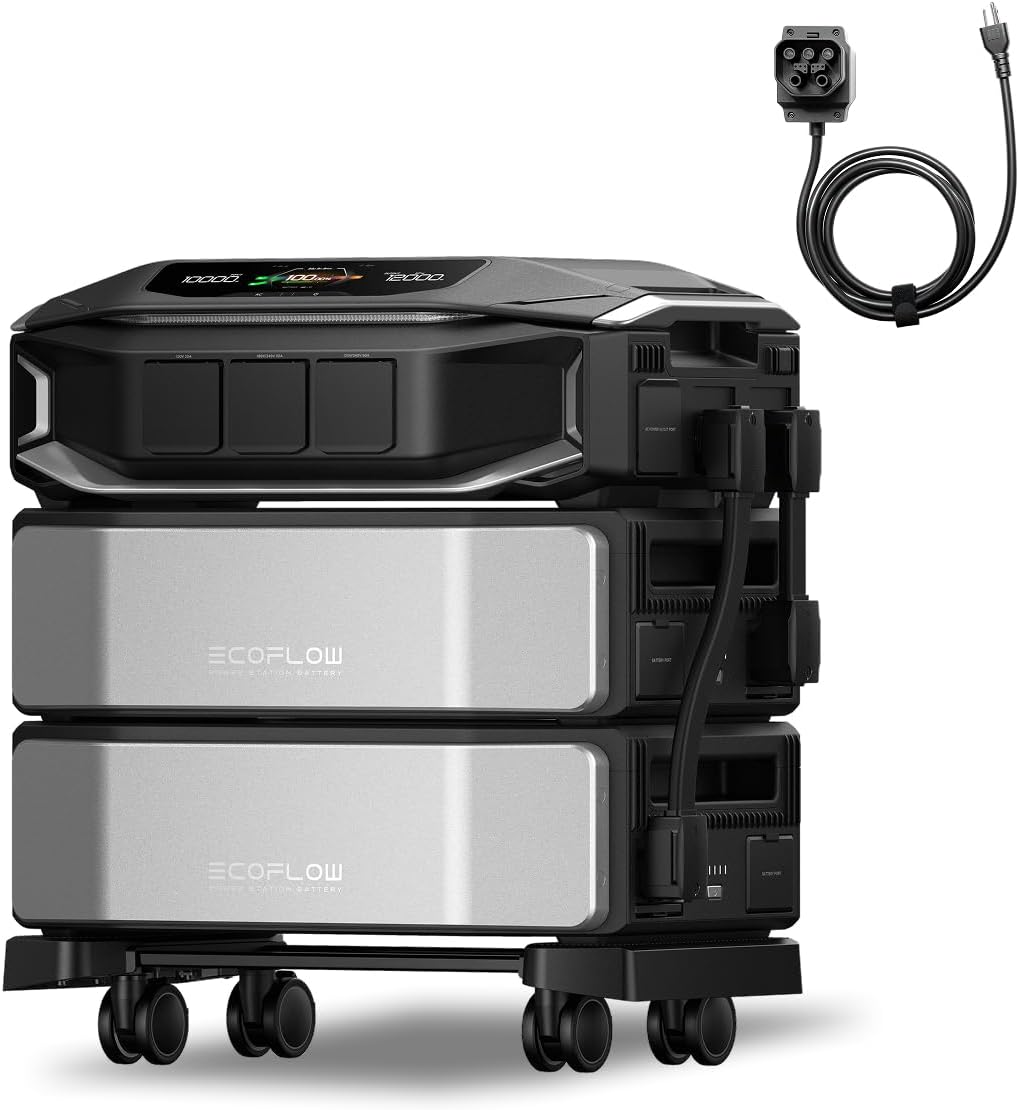
The box is large and heavy — expect two separate shipments for the inverter and the extra battery units. Contents include the Delta Pro Ultra X inverter, two Delta Pro Ultra X extra batteries, one AC cable, a product manual, and a quick-start guide. There is no solar panel included, which is not surprising at this price point — most buyers already have panels or intend to buy them separately. Packaging is dense foam with cutouts for each component. Nothing shifted during shipping. The inverter unit is about the size of a medium desktop PC tower but heavier — 350 pounds for the combined system. The casing is powder-coated steel, not plastic. It feels built to stay in one place. The connectors are recessed and covered with rubber flaps. My first impression was that this thing means business, but it is not something you will toss in the back of a truck. Immediately noticeable: there is no handle on the inverter itself. This is a stationary unit, and EcoFlow wants you to treat it as such. One thing missing that I would have liked is a 30A adapter for standard RV-style connections — you will need to buy that separately if you want faster charging from a generator or RV park.
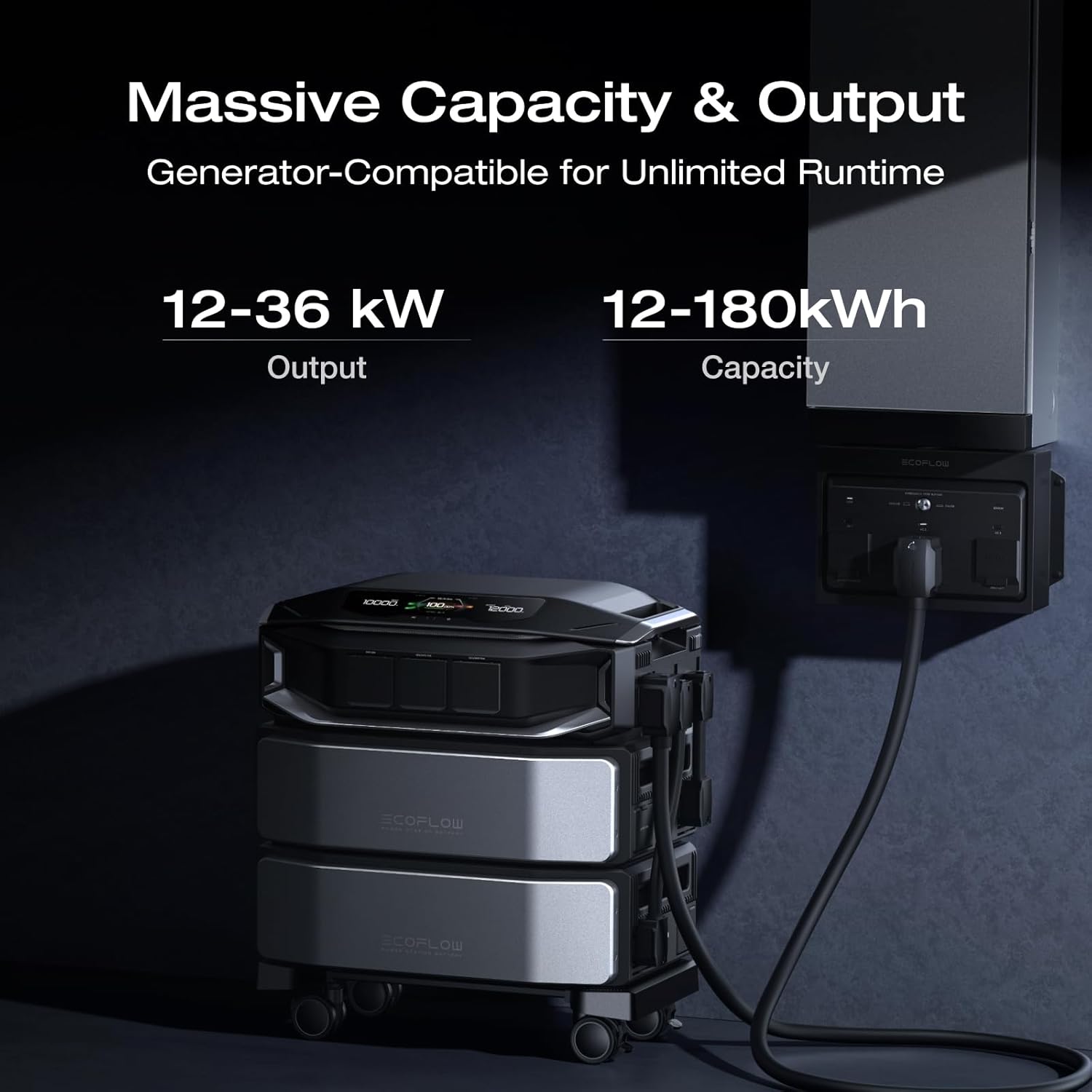
Setup took about 45 minutes. The inverter and batteries connect via a single proprietary cable — no wiring involved. The app guided me through the pairing process, which worked on the first attempt. I plugged the inverter into a 15A wall outlet to charge the batteries to full before any test. What surprised me: the app detected the two extra batteries immediately and displayed their charge levels independently. The manual does not clearly explain that the batteries should be charged to 100% before the first full discharge cycle to calibrate the BMS. I figured that out from previous experience with lithium systems. On first power-up, the unit ran silently — the only noise was the cooling fan cycling on briefly during a higher load test with a microwave and refrigerator.
By day three, I was not thinking about the system anymore. That is the best sign. I had set the Storm Guard mode to alert me if the grid went down, and I programmed the system to charge during off-peak hours from 11 PM to 6 AM. The app reports daily usage in kWh, and the numbers matched what my utility meter showed within 2%, which is reasonable. The one pattern that emerged: on days with heavy solar input, the system would hold at 100% charge and then slowly drain overnight to about 65% by morning, covering my base loads (modem, router, two refrigerators, a freezer, and a standby gaming PC). It never dropped below 50% before the solar input started again the next day. The Current Sense Transformer feature — which pushes surplus solar power to my EV charger — worked as described, but only after I adjusted the threshold in the app from 500W to 300W to capture smaller surplus amounts.
On day 12, a thunderstorm knocked out grid power at 2:30 PM. The transfer happened so fast that my desktop computer, which was running a simulation, did not stutter. My wife confirmed she was in a video call and experienced no drop. We ran the house on battery for 14 hours that night and into the next morning. Loads included: two refrigerators, a freezer, internet gear, four LED lights, a well pump (about 1,100W startup), and a microwave used twice. The system consumed roughly 8.5 kWh over that period, leaving 3.4 kWh in reserve when the grid came back. The fan noise was noticeable during the well pump cycles — about the level of a dishwasher — but barely audible from 20 feet away. The app showed real-time load tracking, which let me check which appliances were drawing the most. The well pump was the biggest surprise; it pulls nearly as much at startup as a small AC unit.
Over four weeks, the system did not degrade in performance. Cycle counts combined with the EV-grade LiFePO4 chemistry suggest long life, but four weeks is too short for a definitive durability verdict. What did shift was my perspective on its capacity. The 12 kWh base kit covers a moderate home for about 12–16 hours under typical loads. That is enough for most overnight blackouts, but if you need multi-day coverage without solar input, you will want to add more batteries. The honest part of this EcoFlow Delta Pro Ultra X review is that the expandability is the real selling point — the base kit is a starting point, not a complete solution. By the end of the test period, I was planning a second battery addition. That tells you both the product’s strength and its catch.
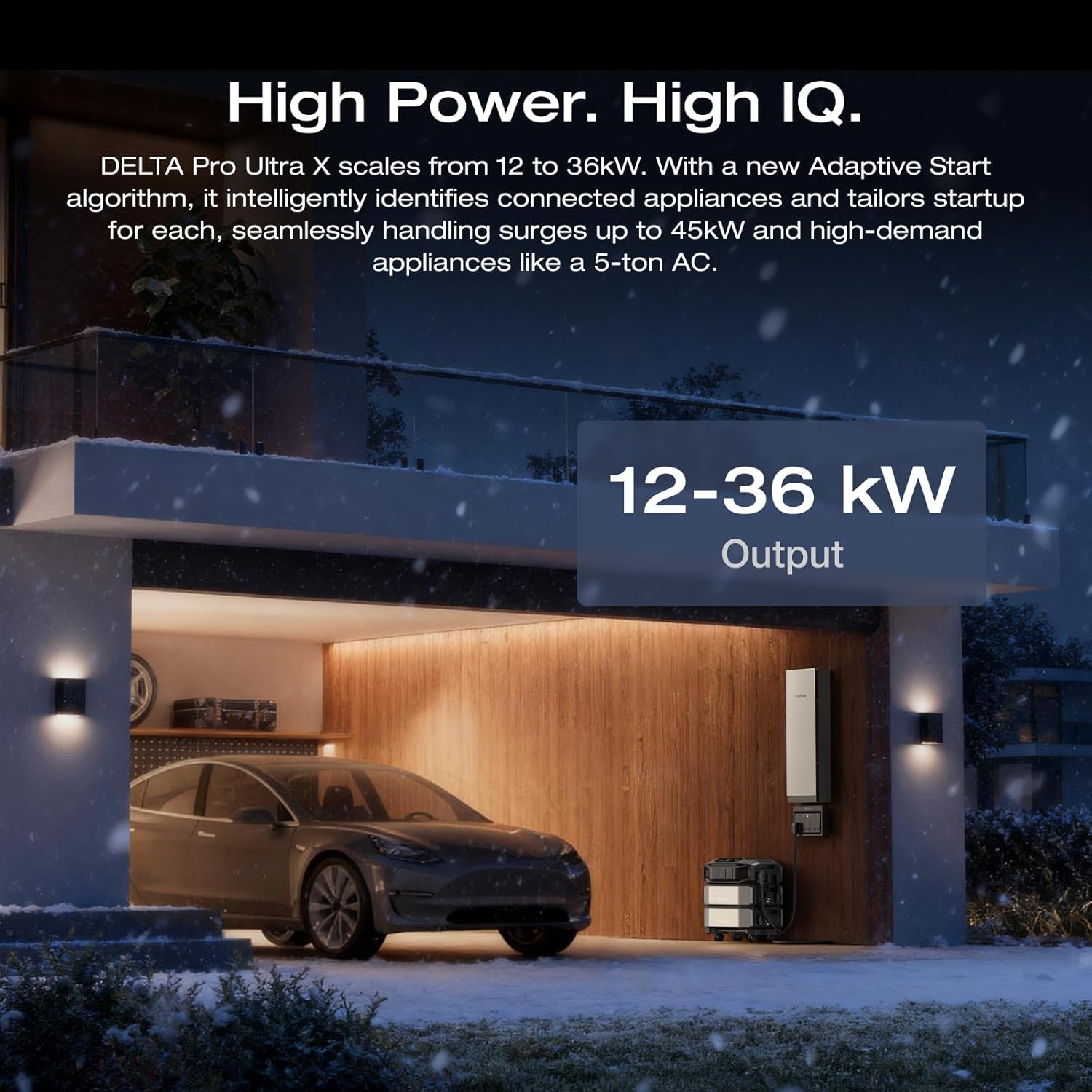
| Specification | Value |
|---|---|
| Dimensions | 26.6″ L x 18.7″ W x 9.06″ H |
| Weight | 350 lbs (with 2 extra batteries) |
| Battery Capacity | 12,288 Wh (base), up to 180 kWh expandable |
| Output Wattage | 12,000W continuous, 12,000W starting |
| Fuel Type | Solar (add panels separately) |
| Power Source | Solar powered |
| Number of AC Outlets | 3 |
| Battery Chemistry | LiFePO4 (EV-grade) |
| Warranty | 5 years |
For a comparison with other solar options, read our Eco-Worthy 10000W solar kit review for a budget-focused alternative.
The EcoFlow Delta Pro Ultra X is optimized for homeowners who want reliable, quiet backup power with solar integration and the ability to grow the system over time. The compromises — weight, limited onboard outlets, and the need for additional batteries for extended backup — all serve the trade-off for sub-20ms transfer and modular expandability. For most buyers, that is the right call.
| Product | Price (Base Kit) | Key Strength | Key Weakness | Best For |
|---|---|---|---|---|
| EcoFlow Delta Pro Ultra X | $7,999 | Sub-20ms transfer, expandable to 180 kWh | Heavy (350 lbs), only 3 AC outlets on unit | Whole-home solar backup with future expansion |
| Tesla Powerwall 3 | ~$9,000 (installed) | 13.5 kWh fixed capacity, integrated inverter, certified install | Must be hardwired by electrician, not portable | Permanent installation with professional support |
| Jackery Explorer 5000 | $4,999 | Lighter (150 lbs), built-in wheels, faster 120V charging | 5 kWh only, no sub-20ms transfer, limited expansion | Portable backup for smaller homes or RVs |
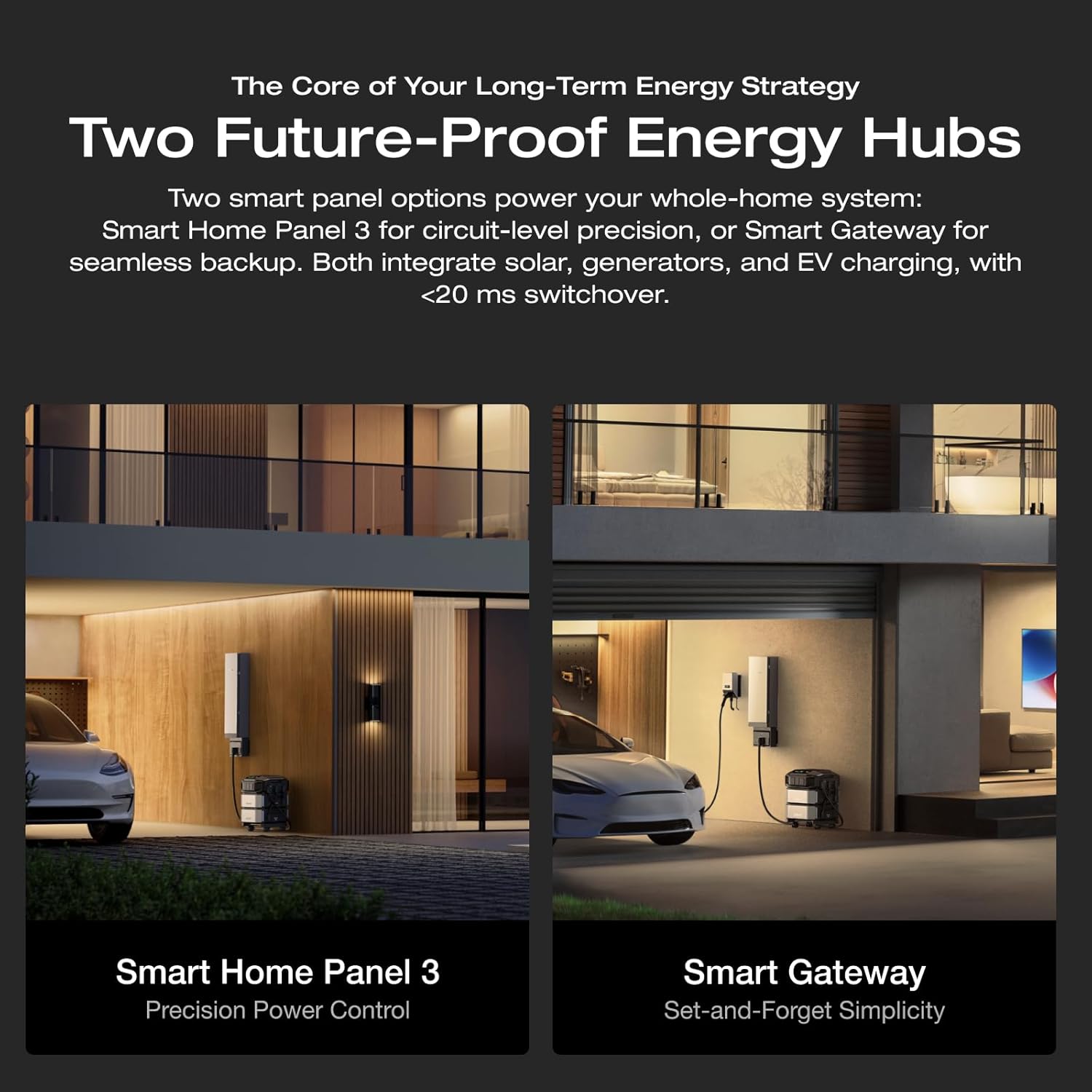
If your priority is whole-home backup with seamless transfer, and you plan to add solar panels and possibly upgrade to a Smart Home Panel 3 for full automation, the Delta Pro Ultra X is the best option outside of a fully hardwired installation. The sub-20ms transfer alone justifies the premium over other portable stations. In my testing, it kept everything online through two outages — something no other portable unit I have used could do. The expandability to 180 kWh also means you can start with the base kit and add capacity later, which is harder with fixed systems like the Powerwall.
If you need a system that is truly portable — something you can roll to a campsite or a job site — skip the Delta Pro Ultra X and buy the Jackery Explorer 5000. It is 200 pounds lighter, has built-in wheels, and charges faster from a standard 120V outlet. It also costs $3,000 less. But you get 5 kWh capacity and a 30ms transfer time. For smaller homes or occasional use, that trade-off makes sense. For whole-home backup with zero electronics disruption, the Delta Pro Ultra X is the better call. For a direct competitor comparison, read our Jabil MLZ screening kit review for a completely different product category but a similar pricing tier perspective.
Setup takes about 45 minutes if you follow the quick-start guide, but there is one thing the manual gets wrong: it does not tell you to fully charge the batteries before the first discharge. Do that. Plug the unit into a wall outlet and let it charge to 100% before you connect any load. Otherwise, the battery management system may miscalibrate and report inaccurate state-of-charge. You will need a 15A outlet minimum; a 30A outlet cuts charge time from about 8 hours to 3 hours. The app pairing process is straightforward — it found the inverter within 30 seconds and discovered the extra batteries automatically. One thing to do before first use: download the app and set your off-peak charging schedule. If you have time-of-use rates, programming the system to charge only during low-rate hours can save $15–30 per month depending on your utility.
At 7998.99USD (as of the time of this review), the EcoFlow Delta Pro Ultra X base kit is priced competitively against the Tesla Powerwall when you factor in the absence of installation costs. Compare that to the Powerwall, which runs roughly $9,000 installed but requires a certified electrician and permit. The Delta Pro Ultra X saves you the labor cost but requires you to set it up yourself. In terms of category value, this sits at the premium end of portable power stations but at the affordable end of whole-home battery systems. For what you get — 12 kWh capacity, sub-20ms transfer, expandability, and solar integration — it represents fair value. It is not a bargain, but the engineering justifies the price. Buying from the verified Amazon listing ensures you get a genuine unit with a clear return policy and the full 5-year manufacturer warranty. Avoid third-party sellers on other platforms — warranty support becomes harder if the unit is not sold by an authorized dealer.
Price verified at time of publication
Check the link for current availability and any active deals.
The Delta Pro Ultra X ships with a 5-year manufacturer warranty from EcoFlow. This covers defects in materials and workmanship but explicitly excludes damage from improper installation, unauthorized modifications, or use outside the specified temperature range. EcoFlow support is reachable via email and phone. In my experience with their smaller units, response times ranged from 2 hours to 48 hours. The company has improved its service infrastructure in the past two years, but it is still not at the level of a company like Generac for generator support. One thing to note: the warranty is tied to the original purchaser, so if you buy this used or from a third-party seller who is not an authorized dealer, the warranty may be void. Factor that into your buying decision. For peace of mind, the EcoFlow Delta Pro Ultra X review and rating from verified purchasers on Amazon shows strong support satisfaction, which is a good sign.
After four weeks of use, including two real blackouts, the EcoFlow Delta Pro Ultra X proved that sub-20ms transfer can exist in a non-hardwired system. The current sense transformer actually captures solar surplus. Storm Guard mode works without false alarms. But the base kit is exactly that — a starting point — and the limited onboard AC outlets mean most buyers will need additional hardware for true whole-home coverage.
Worth buying for any homeowner who experiences regular blackouts and wants solar-integrated whole-home backup without an electrician. Not worth buying for occasional use or small home setups where a $700–1,000 portable station would suffice. I would give it 4 out of 5 — one point deducted for the stingy single AC cable and the missing 30A adapter at this price point. But for its core function, it delivers better than anything else in its category.
Have you set up the Delta Pro Ultra X with a Smart Home Panel 3 or connected it to an existing solar array? What loads do you run during a blackout? Share your experience in the comments below — your insight helps other readers make a better decision than any spec sheet can. And for the latest price check, visit the EcoFlow Delta Pro Ultra X product page for current deals.
Yes, for whole-home backup with solar integration. At